
Orchard Piping and Drip Irrigation: from the Well to the Tree
A guide to orchard piping for drip irrigation: which pressure class and size of polyethylene main line, 16 and 20 mm lateral tubing, drip tape, micro tubing, ball valves and compression fittings, clamp saddles, and the list of items to prepare for an order.
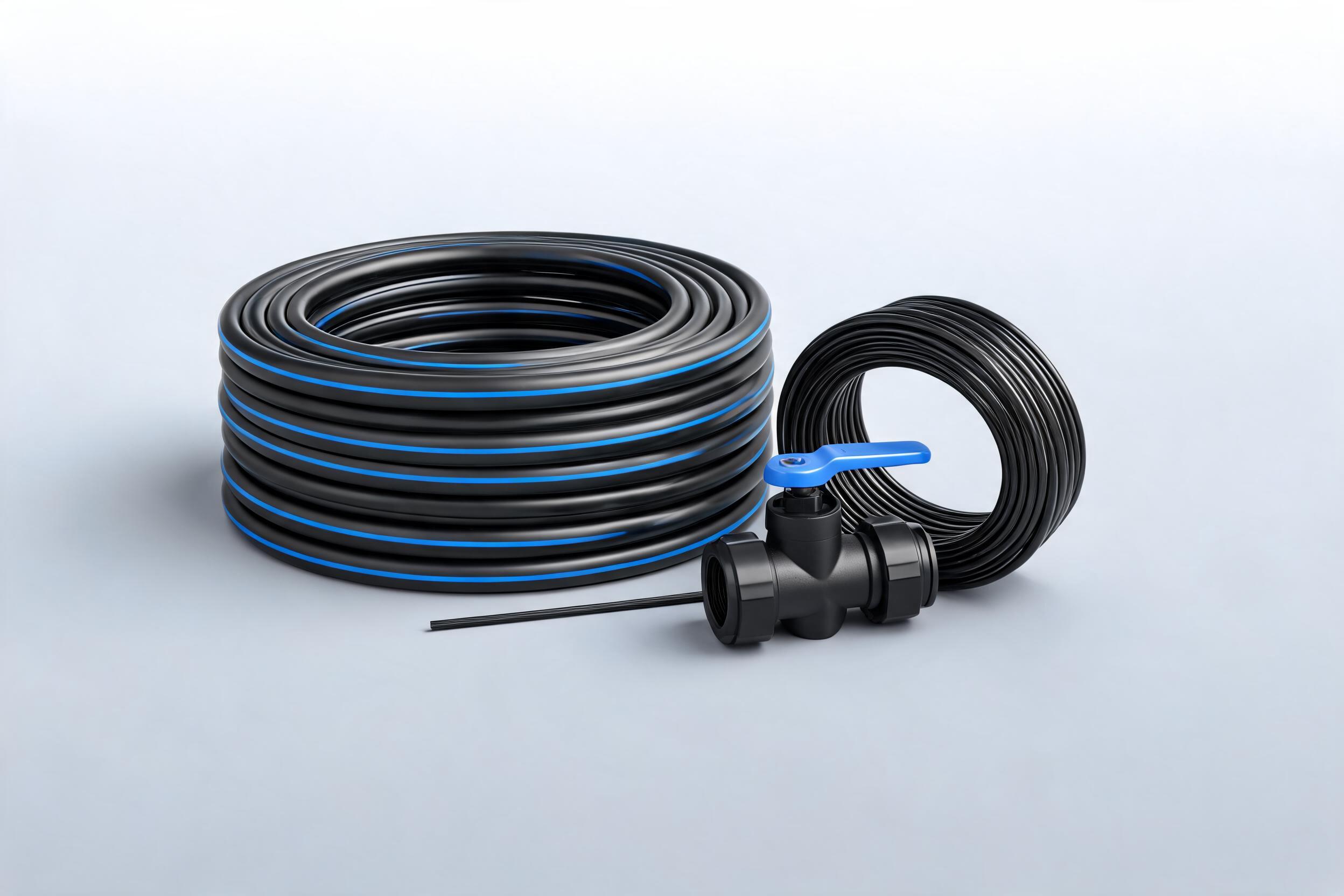
Where does orchard piping start?
Orchard piping for drip irrigation is a chain that starts at the water source and ends at the foot of each tree. The source may be a well, a storage pond or an agricultural water connection. After the source and the pump, the main line carries water to the head of each block, sub-mains spread it between the rows, and finally lateral tubing, drip tape or micro tubing delivers it to the plant's roots.
A common mistake is to run the whole system in one pipe size. The main line carries all of the orchard's water and needs the right diameter and pressure class, while a lateral carries only one row's water and is made of soft, light polyethylene. In this guide we explain each link of the chain separately and show the product and published sizes for each.
This article is about choosing pipe and fittings, not hydraulic design. Pump flow, emitter spacing and the number of irrigation blocks depend on the trees, the soil and the water available, and the layout is best drawn up by an irrigation specialist. Once the layout is ready, this guide helps you write a correct and complete shopping list.
Main line: which pressure class and size of PE water pipe?
An orchard main line uses blue-striped polyethylene water pipe, which comes in two grades, PE100 and PE80. In our catalogue PE100 pipe is rated from 4 to 25 bar and PE80 pipe from 4 to 16 bar. The pressure class is set by the pressure the pump creates in the line; the higher the bar rating, the thicker the wall and the heavier the pipe.
For example, 63 mm (2 inch) PE100 pipe at 6 bar has a 2.5 mm wall and weighs 0.494 kg/m, and at 10 bar a 3.8 mm wall and 0.721 kg/m. 110 mm (4 inch) PE100 pipe at 10 bar has a 6.5 mm wall and weighs 2.17 kg/m. Choosing a higher rating than needed only raises the cost; choosing a lower one risks bursting.
Diameters up to 110 mm come in 50, 100 and 200 m coils, which suit long orchard lines and need fewer joints. From 63 mm up there are also 6 and 12 m bars. The 63, 90 and 110 mm size pages show every pressure class of each size with wall and weight, and the weight calculator estimates the weight of the whole line.
PE100 or PE80 for orchard piping?
Both grades are used for irrigation. PE100 has a higher long-term strength, so it needs a thinner wall for the same pressure class. The result is that at the same diameter and the same bar rating, PE100 pipe is a little lighter and has a larger inside diameter for the water. PE80 pipe is also common in rural water networks and agricultural irrigation.
Look at the catalogue table: a 63 mm pipe with a 3.8 mm wall is rated 10 bar in PE100 and 8 bar in PE80. So to reach 10 bar with PE80 you need the thicker 4.7 mm wall. When comparing the price of the two grades, always compare two pipes with the same pressure class, not two pipes with the same wall thickness.
16 mm drip tubing, lateral tubing and micro tubing
The 16 mm drip irrigation pipe people ask about is lateral tubing: a pipe of light polyethylene (LDPE) that is soft and flexible and is supplied in coils. Our catalogue lists lateral tubing in two diameters, 16 and 20 mm. It runs along the tree rows and the emitters are fitted onto it; it is connected to the sub-main with lateral fittings and needs no welding.
Micro tubing is a very narrow tube, 4 or 6 mm in diameter, that carries water from the lateral or emitter to the foot of a tree, a pot or a shrub. In orchards where trees are widely or irregularly spaced, or in greenhouses and landscaping, micro tubing helps deliver water exactly where it is needed. It is cut with scissors.
Drip tape or lateral tubing?
Drip tape is a flat, thin-walled 16 mm tube with emitters or water outlets already built into its wall. It is used mostly for row and seasonal crops such as vegetables and comes in 1000 m rolls: slit drip tape at roll weights from 9 to 11 kg, and flat-emitter drip tape with built-in flat emitters, both with 10, 15, 20 or 30 cm spacing.
In an orchard, where the trees live for many years and the system must last, lateral tubing with emitters or micro tubing is usually chosen, because its wall is sturdier and an emitter can be placed exactly at each tree. Drip tape is also seen in newly planted orchards or between rows with seasonal crops. Make the final choice by crop type and an irrigation specialist's advice.
Valves and fittings for the irrigation line
To join polyethylene main and sub-main pipes in an orchard, compression fittings are the most common choice, because they are tightened without a welding machine or power and can be opened if the route changes later. Compression couplings, elbows, tees, reducers and end caps run from 20 to 125 mm in our catalogue. The compression end cap closes the end of a line and is opened to flush the line at the end of the season.
To open and close the water to each orchard block, the double-ended compression PE ball valve is used; it fits straight onto polyethylene pipe and opens or closes with a quarter turn of the handle, in sizes from 20 to 110 mm. To take a small outlet from the main without cutting it, a compression clamp saddle with a 1/2, 3/4 or 1 inch outlet is bolted onto 32 to 315 mm pipe.
At the pump station and the head of the main line, where the connections are flanged, a cast iron Y-strainer catches suspended particles, sand and sediment before they enter the network and protects the pump and valves. Polyethylene pipe is connected to the pump or strainer flange with a stub end and a backing ring, as explained in our guide on how to connect polyethylene pipe.
Orchard drip irrigation: the order list
The table below lists the main items of orchard piping from the source to the tree, with the published sizes and what to state when ordering each item. If water comes from a well that needs a polyethylene casing, our PE well casing pipe is published in diameters from 110 to 500 mm and in 6 and 12 m bars.
Read pipe lengths off the orchard plan and add a little for cutting waste and bends. Count the fittings from the plan too: one tee or saddle per branch, one reducer per size change, and one end cap per line end. Send the full list through the contact page; we give technical advice on size and pressure class before you buy and also deliver to other cities.
| System part | Product | Published size or type | State in your order |
|---|---|---|---|
| Well casing | PE well casing pipe | 110 to 500 mm, 6 and 12 m bars | Diameter, wall, bar length, quantity |
| Head of the main line | Cast iron Y-strainer | DN32 to DN400 | DN size and PN 10 or PN 16 |
| Main and sub-main | PE100 or PE80 water pipe | PE100: 4 to 25 bar; PE80: 4 to 16 bar | Diameter, bar or SDR, grade, coil or bar, length |
| Opening and closing blocks | Double-ended compression PE ball valve | 20 to 110 mm | Pipe diameter, quantity |
| Couplings, elbows, tees, reducers, caps | Compression fittings | 20 to 125 mm | Item type, diameter or both diameters, quantity |
| Outlet from the main | Compression clamp saddle | 32 to 315 mm pipe, 1/2 to 1 inch outlet | Main pipe diameter and outlet size |
| Tree rows | LDPE lateral tubing | 16 and 20 mm, coils | Diameter and length |
| Row or seasonal crops | Slit or flat-emitter drip tape | 16 mm, 10, 15, 20 or 30 cm spacing | Type, spacing, roll weight, number of rolls |
| Water to the plant | Micro tubing | 4 and 6 mm, coils | Diameter and length |
Table of Contents
Caspian Sanat ZAAL
Product technical guides
These guides are based on the standards and technical data of the products themselves. Contact us to confirm the size and pressure class for your project.