
Difference Between PE100 and PE80 Polyethylene Pipe
A review of the differences between two widely used polyethylene grades in long-term strength, dimension ratio, and water pipeline applications.
Material Grades and Minimum Required Strength (MRS)
In polyethylene pipeline engineering, raw material grades are designated according to their Minimum Required Strength (MRS). This parameter defines the hydrostatic hoop stress in megapascals that the polymer withstands at a base reference temperature of 20 °C over a 50-year design lifetime. In PE100 compound, the MRS is rated at 10 MPa, whereas PE80 compound is evaluated at 8 MPa. This fundamental distinction in mechanical behaviour forms the primary difference between these two materials in water transmission.
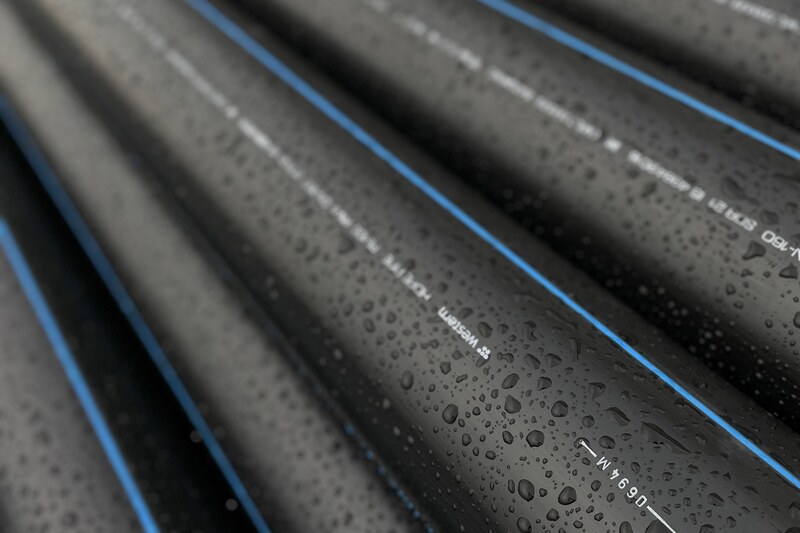
The difference in minimum required strength directly impacts allowable design stress. Allowable design stress is calculated as 8.0 MPa for PE100 and 6.3 MPa for PE80. Both grades are manufactured in conformity with international standards ISO 4427 and EN 12201-2 for potable water pipelines and pressurised agricultural irrigation, where co-extruded longitudinal blue stripes on the black exterior clearly mark them for water service applications.
Standard Dimension Ratio (SDR) and Wall Thickness
The Standard Dimension Ratio (SDR) represents the ratio of outside diameter to wall thickness. Due to the higher design stress of PE100, achieving a given nominal pressure class requires a thinner wall than PE80. For instance, to sustain a nominal pressure of 16 bar, PE100 pipe is supplied in SDR 11, whereas PE80 pipe requires SDR 9 with a substantially thicker pipe wall.
The reduced wall thickness of PE100 pipes results in a lower weight per metre compared to PE80 pipes of identical pressure rating. This weight reduction in transmission pipelines lowers freight and handling costs while providing an expanded internal cross-sectional area for fluid flow. Nevertheless, at lower nominal pressures such as PN10 or PN6 in branch networks, both grades satisfy system hydraulic requirements.
Dimensional Range and Supply Forms in Coils and Bars
Regarding dimensional envelopes, PE80 pipes are supplied in outside diameters from 16 to 630 mm in pressure classes PN4 to PN16, mostly for orchard irrigation, rural water service connections and well lines. PE100 pipes cover 20 to 630 mm across pressure ratings from PN4 to PN25, making them suited for municipal water transmission mains and high-pressure trunklines.
Both products in small diameters up to 110 mm can be supplied in continuous coils of 100 m and 200 m, which minimizes intermediate pipeline joints thanks to polyethylene flexibility. For diameters from 63 mm upwards, delivery is made in straight 6 m and 12 m bars. Storing straight bars on flat ground and coils lying flat prevents circular cross-section deformation before installation.
Grade Selection Guidelines for Projects
Selecting between these two products depends on hydraulic operating pressure and installation conditions. In rural service lines, agricultural branches, and low-pressure farm irrigation, PE80 pipes are widely utilized because of their flexibility and convenient handling. However, in high-pressure distribution mains and municipal trunklines with larger diameters, PE100 pipes are consistently preferred by designers due to higher mechanical strength and raw material weight savings.
Nominal pressure ratings for both grades are established at a fluid temperature of 20 °C, and appropriate derating factors must be applied if water temperatures rise. To obtain the current price and confirm the right size and pressure class for your project, submit your requirements via the site inquiry list or contact our sales team by phone.
Table of Contents
Caspian Sanat ZAAL
Product technical guides
These guides are based on the standards and technical data of the products themselves. Contact us to confirm the size and pressure class for your project.