
Polyethylene Pipe Weight Table, PE100 and PE80, 16 to 560 mm
Weight per metre of polyethylene pipe from 16 to 560 mm for every SDR class, PE100 and PE80 pressure classes at two design coefficients, coil and bar lengths, and how to work out order weight and price per metre from weight.
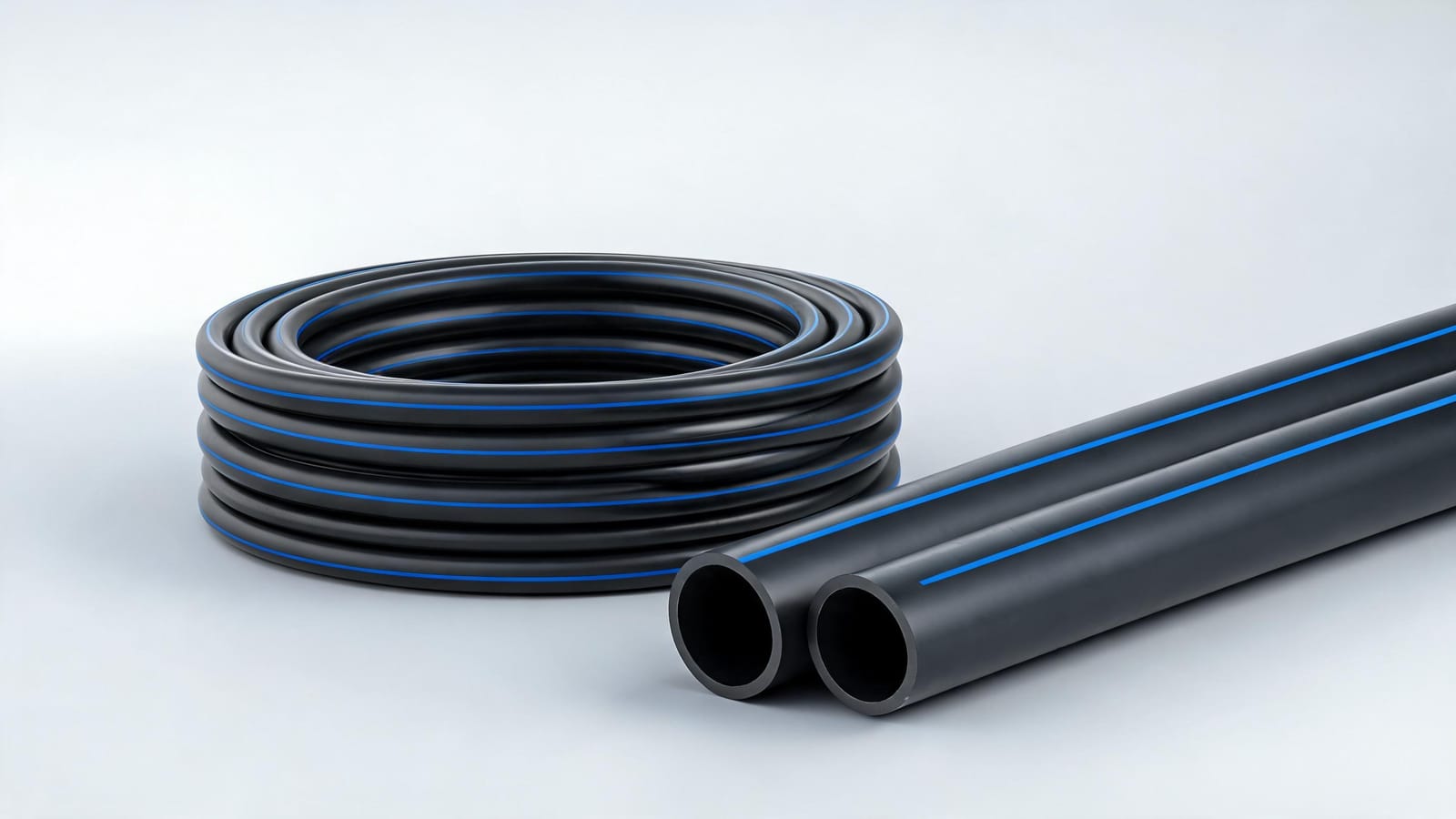
What does the weight of a polyethylene pipe depend on?
The weight per metre of a polyethylene pipe depends on two dimensions: the outside diameter and the wall thickness. The wall thickness is set by the SDR, the ratio of outside diameter to wall thickness, so the smaller the SDR, the thicker the wall, the heavier the pipe and the higher its working pressure.
Knowing the weight matters when you buy, because polyethylene pipe is priced by the kilogram and the transport cost and number of trucks also follow from the total order weight. If a delivered pipe weighs less than the table, its wall is probably thinner than its class requires, so comparing the real weight with the table is the simplest check before accepting a load.
Polyethylene pipe weight per metre, 16 to 560 mm
The table below gives the weight per metre of polyethylene pipe in kilograms for 24 outside diameters from 16 to 560 mm and ten SDR classes from SDR 41 to SDR 6. Along each row, moving from a large SDR to a small one, the wall gets thicker and the weight per metre rises. An empty cell means our weight table has no value for that combination.
These weights are the same for PE100 and PE80 pipe, because at a given SDR both grades have identical dimensions and differ only in pressure class. The wall thickness for every size and class is on that pipe’s page on this site, and in the simulator you can pick any size and see the weight of a coil or a bar.
| OD (mm) | SDR 41 | SDR 33 | SDR 26 | SDR 21 | SDR 17 | SDR 13.6 | SDR 11 | SDR 9 | SDR 7.4 | SDR 6 |
|---|---|---|---|---|---|---|---|---|---|---|
| 16 | — | — | — | — | — | — | — | 0.092 | 0.103 | 0.125 |
| 20 | — | — | — | — | — | 0.102 | 0.118 | 0.134 | 0.164 | 0.182 |
| 25 | — | — | — | — | 0.125 | 0.151 | 0.173 | 0.202 | 0.243 | 0.281 |
| 32 | — | — | — | — | 0.198 | 0.235 | 0.282 | 0.331 | 0.39 | 0.458 |
| 40 | — | — | 0.229 | 0.251 | 0.299 | 0.36 | 0.434 | 0.514 | 0.607 | 0.708 |
| 50 | — | 0.29 | 0.317 | 0.378 | 0.458 | 0.555 | 0.673 | 0.796 | 0.945 | 1.1 |
| 63 | 0.364 | 0.399 | 0.494 | 0.58 | 0.721 | 0.873 | 1.05 | 1.26 | 1.47 | 1.73 |
| 75 | 0.457 | 0.551 | 0.675 | 0.828 | 1.02 | 1.24 | 1.47 | 1.76 | 2.09 | 2.44 |
| 90 | 0.643 | 0.79 | 0.978 | 1.2 | 1.46 | 1.77 | 2.12 | 2.54 | 3 | 3.51 |
| 110 | 0.943 | 1.17 | 1.43 | 1.85 | 2.17 | 2.62 | 3.14 | 3.78 | 4.49 | 5.24 |
| 125 | 1.23 | 1.51 | 1.84 | 2.35 | 2.76 | 3.37 | 4.08 | 4.87 | 5.77 | 6.75 |
| 140 | 1.54 | 1.88 | 2.32 | 2.83 | 3.46 | 4.22 | 5.08 | 6.11 | 7.25 | 8.47 |
| 160 | 2 | 2.42 | 3.04 | 3.72 | 4.52 | 5.5 | 6.67 | 7.96 | 9.44 | 11 |
| 180 | 2.49 | 3.07 | 3.79 | 4.67 | 5.71 | 6.98 | 8.42 | 10.1 | 11.9 | 14 |
| 200 | 3.05 | 3.84 | 4.69 | 5.78 | 7.05 | 8.56 | 10.4 | 12.4 | 14.8 | 17.2 |
| 225 | 3.86 | 4.77 | 5.89 | 7.3 | 8.93 | 10.9 | 13.1 | 15.8 | 18.6 | 21.8 |
| 250 | 4.83 | 5.92 | 7.3 | 8.93 | 11 | 13.4 | 16.2 | 19.4 | 23 | 27 |
| 280 | 5.58 | 7.4 | 9.1 | 11.3 | 13.7 | 16.8 | 20.3 | 24.3 | 28.9 | 33.8 |
| 315 | 7.52 | 9.37 | 11.6 | 14.2 | 17.4 | 21.2 | 25.6 | 30.8 | 36.5 | 42.7 |
| 355 | 9.55 | 11.8 | 14.6 | 18 | 22.1 | 26.9 | 32.5 | 39.1 | 46.3 | 54.3 |
| 400 | 12.1 | 15.1 | 18.6 | 22.9 | 28 | 34.1 | 41.3 | 49.6 | 58.8 | 68.9 |
| 450 | 15.3 | 19 | 23.5 | 28.9 | 35.4 | 43.2 | 52.3 | 62.7 | 74.4 | — |
| 500 | 19 | 23.4 | 28.9 | 35.7 | 43.8 | 53.3 | 64.5 | 77.3 | 91.8 | — |
| 560 | 23.6 | 29.4 | 36.2 | 44.7 | 54.8 | 66.9 | 80.8 | 97 | — | — |
Weight of 110, 63 and 200 mm polyethylene pipe
A 110 mm pipe at SDR 11 weighs about 3.14 kg per metre, so a 6 m bar is about 19 kg and a 12 m bar about 38 kg. The same pipe at SDR 17 weighs about 2.17 kg per metre and at SDR 21 about 1.85 kg, which shows how directly the pressure class you choose drives the weight and cost of an order.
A 63 mm pipe at SDR 11 weighs about 1.05 kg per metre, and a 100 m coil of it weighs about 105 kg. A 200 mm pipe at SDR 11 weighs about 10.4 kg per metre, so a 6 m bar comes to about 62 kg. Work out any other size from the table above in the same way.
PE100 and PE80 pressure class and the design coefficient
At a given SDR, PE100 pipe withstands more pressure than PE80 because the material is stronger. The pressure class also depends on the design coefficient: with a coefficient of 1.25, SDR 11 is PN16 in PE100 and PN12.5 in PE80; with a coefficient of 1.6 the same two pipes are rated PN12.5 and PN10.
A coefficient of 1.25 is the minimum for water supply in ISO 4427 and is usually the basis of the pressure class printed on the pipe. A coefficient of 1.6 leaves a larger safety margin and makes sense for more critical lines, higher operating temperatures or where water hammer is likely, but choosing it is an engineering decision that should be made with an expert for the line in question.
| SDR | PE100, C = 1.25 | PE80, C = 1.25 | PE100, C = 1.6 | PE80, C = 1.6 |
|---|---|---|---|---|
| 9 | PN20 | PN16 | PN16 | PN12.5 |
| 11 | PN16 | PN12.5 | PN12.5 | PN10 |
| 13.6 | PN12.5 | PN10 | PN10 | PN8 |
| 17 | PN10 | PN8 | PN8 | PN6 |
| 21 | PN8 | PN6 | PN6 | PN5 |
| 26 | PN6 | PN5 | PN5 | PN4 |
How long is a polyethylene pipe coil?
Polyethylene pipe from 20 to 110 mm is supplied in 50, 100 and 200 m coils, and pipe from 63 to 630 mm in 6 m and 12 m bars, so sizes from 63 to 110 mm can be ordered either way. Coils suit long runs with fewer joints, while bars suit the larger diameters that cannot be coiled.
To find the weight of a coil or a bar, multiply the weight per metre from the table by its length. For example, a 100 m coil of 50 mm SDR 11 pipe weighs about 67 kg and a 200 m coil of 32 mm SDR 11 pipe about 56 kg, which matters for handling by hand and for loading.
Working out order weight and price per metre from weight
The total order weight is the weight per metre times the total length, and it decides the type and number of trucks needed. Because polyethylene pipe is priced by the kilogram, the price per metre is the weight per metre times the price per kilogram, so two pipes of the same size but different SDR differ in price roughly in proportion to their weight.
If transport is included, the total transport cost is divided by the total order weight and added to the price per kilogram, and value added tax is calculated separately on top. The material price per kilogram changes daily, so for an exact price, send the size, pressure class and length you need through the inquiry form or call us.
Table of Contents
Caspian Sanat ZAAL
Product technical guides
These guides are based on the standards and technical data of the products themselves. Contact us to confirm the size and pressure class for your project.