
Valves for Polyethylene Pipe: Ball, Gate, Butterfly and Check Valves
Which valve for polyethylene pipe? The double-ended compression PE ball valve for small sizes, ductile iron gate and butterfly valves for large lines, check valves to protect pumps, the Y-strainer, how a flanged valve connects to PE pipe, and a size table.
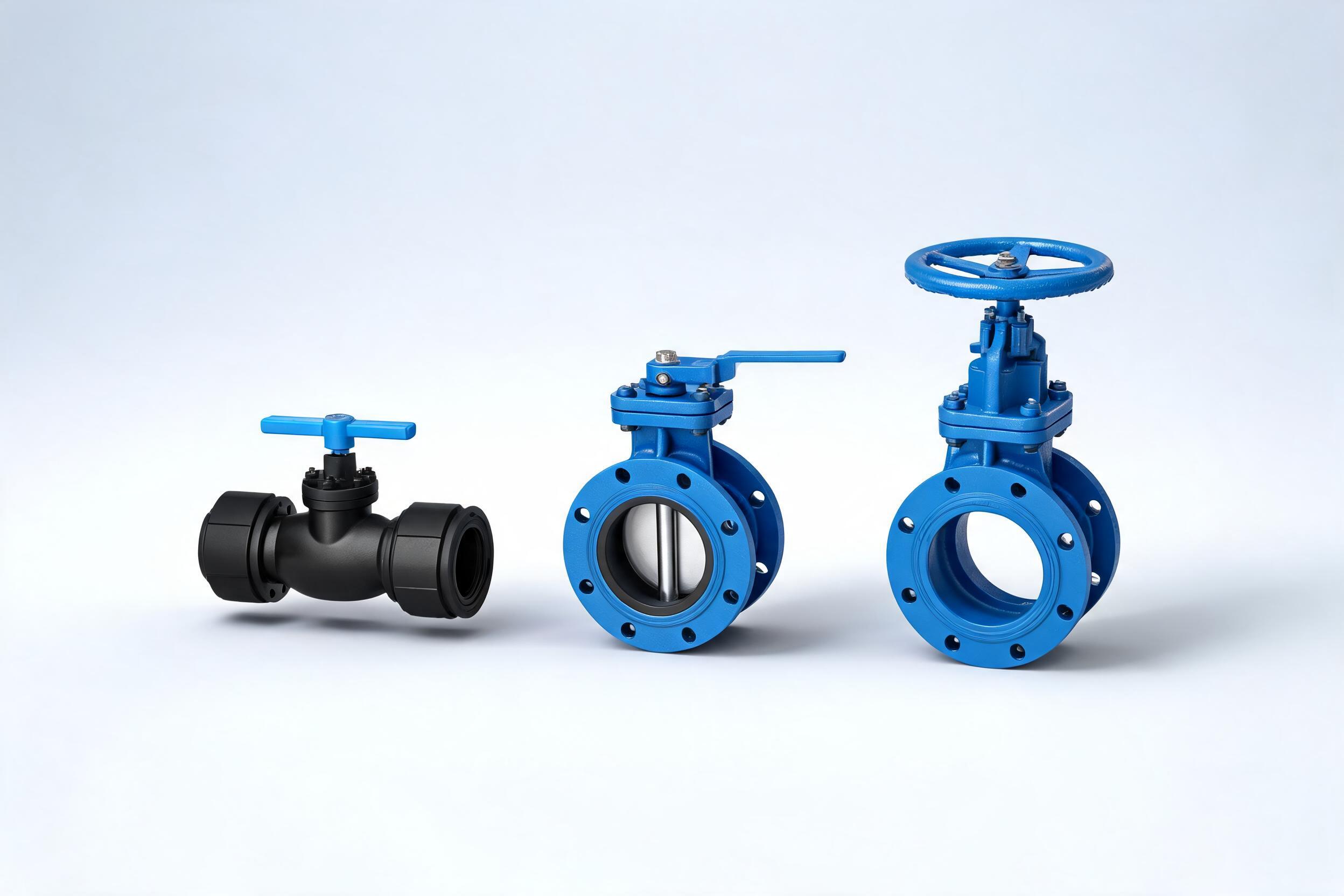
Which valve for polyethylene pipe?
In the market any valve fitted on polyethylene pipe is called a PE valve, but in fact there are two separate families. The first is small polymer valves that fit straight onto polyethylene pipe without welding, such as the double-ended compression ball valve. The second is flanged valves with ductile iron bodies, installed on larger lines and at pump stations.
The boundary between the two families is roughly the boundary between compression and welded fittings. For small irrigation and water lines, the PE ball valve does the job. For main lines, flanged gate, butterfly and check valves are used, and the polyethylene pipe connects to them with a stub end and a backing ring.
In this guide we introduce each valve type with its use, connection and the sizes published in our catalogue, then explain how a flanged valve connects to polyethylene pipe, and finish with a selection table and an order checklist. Polymer valve sizes are given as pipe diameter in millimetres, and flanged valve sizes as DN.
The double-ended compression PE ball valve
The double-ended compression PE ball valve is the most common valve for small polyethylene pipe. Its body is polypropylene and both ends, like compression fittings, fit straight onto polyethylene pipe with a nut and grip ring; so no welding machine or power is needed to install it. A quarter turn of the handle opens or closes the flow fully.
The published sizes of this valve in our catalogue run from 20 to 110 mm. The most searched size is the 2 inch PE valve, used on 63 mm pipe; the 1 inch valve is for 32 mm pipe and the 4 inch valve for 110 mm pipe. It comes with a metal or polymer handle, in double-ended compression or single-ended threaded versions.
The main use of the PE ball valve is opening and closing water to orchard and farm blocks, at the head of irrigation sub-lines and on water supply branches. Because it is built for full on/off service, it is not designed for fine flow control in a half-open position. When you close a ball valve on a line, close it slowly so that no sudden water hammer reaches the pipe and fittings.
Gate and butterfly valves for large lines
The metal-seated gate valve with a ductile iron body and handwheel is the classic on/off valve for raw water and drinking water mains and industrial plants. It has two flanged ends, conforms to EN 1171 and in our published rows runs from DN32 to DN400 in PN 10 and PN 16. When fully open, the flow path is almost unobstructed.
The butterfly valve opens and closes the flow with a round disc that turns a quarter turn, and it is shorter and lighter than a gate valve of the same size. Our catalogue has two kinds: wafer and lug butterfly valves from DN50 to DN600, which sit between two line flanges, and double-flanged butterfly valves from DN150 to DN1200 for large main lines. Both have ductile iron bodies and conform to EN 593.
Depending on size and duty, butterfly valves come with a lever or a gearbox; on large sizes the gearbox makes opening and closing slow and controlled. A wafer butterfly valve is held between two flanges by long bolts, and the lug type has drilled lugs that the bolts pass through.
Check valves and Y-strainers: protecting the pump and network
A check valve lets the flow pass in one direction only and stops water flowing back when the pump switches off. Without a check valve, the water column pushed up the delivery pipe returns after the pump stops and can damage the pump and line equipment. Our catalogue has swing and dual-plate check valves with ductile iron bodies, to EN 12334, in sizes DN50 to DN600.
A Y-strainer separates suspended particles, sand and sediment with an internal screen before they reach the pump, meter and sensitive valves. The Y shape of the body collects the particles in the side branch, and opening the end cover lets the screen be cleaned without opening the whole line. Our Y-strainer has a ductile iron body and two flanged ends, in DN32 to DN400 and PN 10 or PN 16.
At a well or pond pump station, the usual order is a check valve after the pump, then an isolating valve, with the strainer placed where it is easy to clean. The exact layout is set by the system designer; but when buying, order these three items together and in one flange class so that they mate.
How does a flanged valve connect to polyethylene pipe?
Polyethylene pipe cannot be bolted straight to the flange of a cast iron valve. First a polyethylene flange adaptor, or stub end, is butt-fused to the pipe end. The stub end has a wide collar, and a metal backing ring sits behind it. The ring is bolted to the valve flange, and a gasket between the stub end face and the valve flange makes the seal.
Our stub end runs from 63 to 630 mm, and the backing ring comes in two materials: a galvanised or epoxy-coated ring to EN 1092-1 and a ductile iron ring to EN 1092-2, both in PN 10 or PN 16 drilling. The key point is that the ring and the valve flange have the same class; a PN 16 valve is bolted with a PN 16 ring.
Because polyethylene pipe size is given as outside diameter in millimetres and flanged valve size as DN, the two numbers are not the same. When ordering, give the polyethylene pipe diameter together with the valve's DN and PN, so that a stub end and ring that match both the pipe and the valve flange are offered.
Valve selection table for polyethylene pipelines
The table below sets each valve type in our catalogue beside its main use, body and connection, published sizes and reference standard. The PE ball valve is sized by pipe outside diameter in millimetres, and the other valves by nominal size DN. Ask about sizes outside these ranges when you send your enquiry.
In short: for on/off service on small irrigation and water lines, the PE ball valve; for on/off service on main lines, a gate or butterfly valve; to stop backflow after a pump, a check valve; and to catch particles before pumps and sensitive equipment, a Y-strainer.
| Valve | Main use | Body and connection | Published size | Standard |
|---|---|---|---|---|
| Double-ended compression PE ball valve | On/off on small irrigation and water lines | Polypropylene, compression onto the pipe | 20 to 110 mm | — |
| Metal-seated gate valve | On/off on transmission lines | Ductile iron, double-flanged, handwheel | DN32 to DN400, PN 10 and PN 16 | EN 1171 |
| Wafer and lug butterfly valve | On/off, fitted between two flanges | Ductile iron, lever or gearbox | DN50 to DN600 | EN 593 |
| Double-flanged butterfly valve | On/off on large main lines | Ductile iron, double-flanged, gearbox or actuator | DN150 to DN1200 | EN 593 |
| Swing and dual-plate check valve | Stops backflow, protects the pump | Ductile iron | DN50 to DN600 | EN 12334 |
| Cast iron Y-strainer | Catches particles before pumps and valves | Ductile iron, double-flanged | DN32 to DN400, PN 10 and PN 16 | — |
What to state when ordering valves
For a PE ball valve, give the pipe outside diameter in millimetres, double-ended compression or single-ended threaded, the handle material and the quantity. For flanged valves, give the valve type, DN, pressure class PN 10 or PN 16, the operator (handwheel, lever or gearbox) and, for butterfly valves, wafer, lug or double-flanged. If the valve connects to polyethylene pipe, give the pipe diameter too, so that the stub end and backing ring are offered at the same time.
Choosing valves for high pressures, large pump stations and lines at risk of water hammer needs the designer's calculation; in these cases get the specification from the design engineer and copy it into your enquiry. We give technical advice on valves and fittings before you buy; send your list through the contact page and a pro-forma invoice will be prepared.
Table of Contents
Caspian Sanat ZAAL
Product technical guides
These guides are based on the standards and technical data of the products themselves. Contact us to confirm the size and pressure class for your project.