
How to Connect Polyethylene Pipe: to Itself, Metal Pipe, Valves and Pumps
A practical guide to connecting polyethylene pipe: compression fittings without a machine, butt fusion and electrofusion, connecting to valve and pump flanges with a stub end and backing ring, connecting to metal pipe on gas lines, and taking branches; with a table of which fitting and size each job needs.
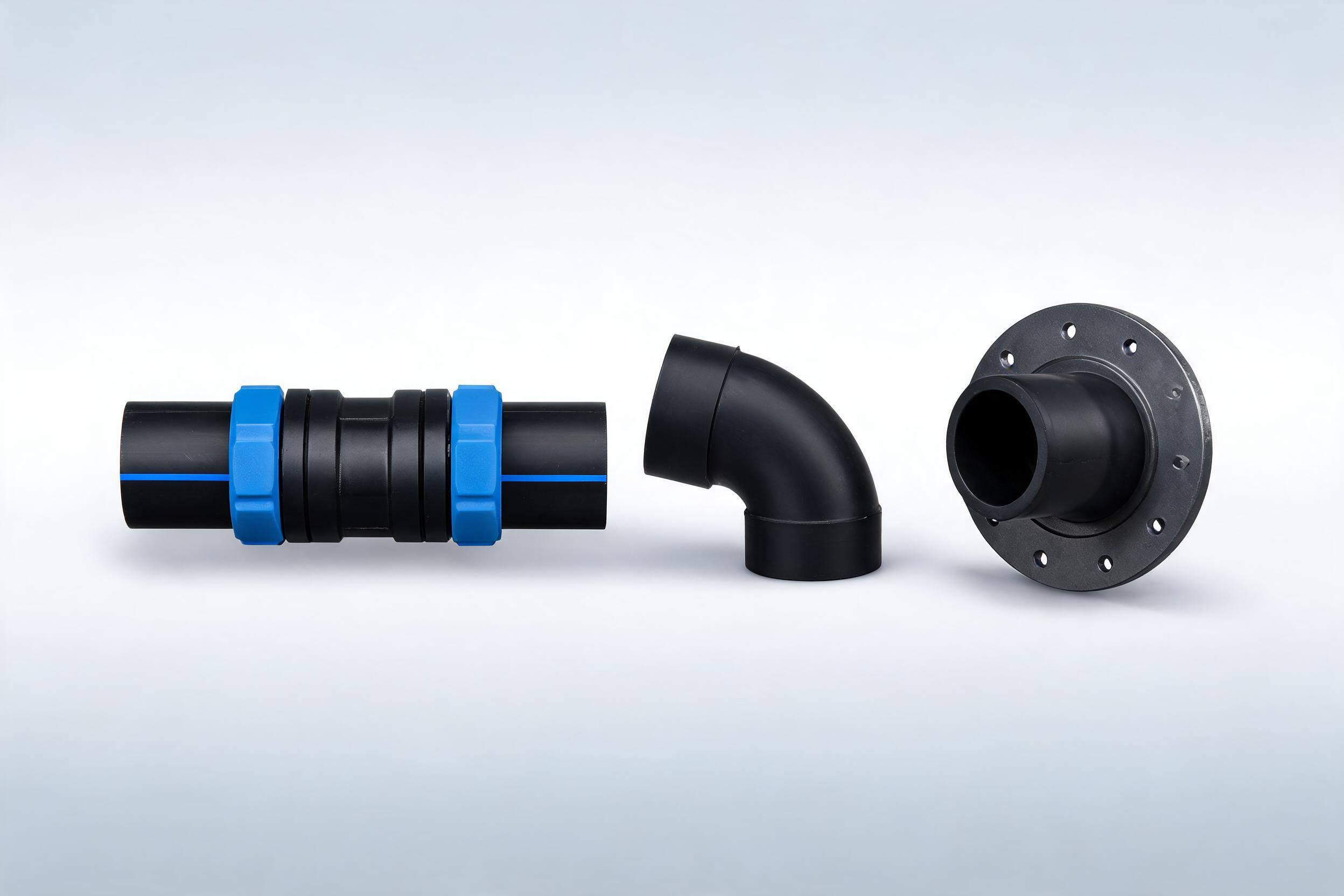
How to connect polyethylene pipe: the three main methods
How you connect polyethylene pipe depends on three things: the pipe diameter, the kind of line (water, irrigation, gas or sewage) and whether the joint must be opened again later or stay permanent. Three methods are common in the Iranian market: compression fittings that are tightened without any machine or power, butt fusion that melts the two pipe ends into one piece, and electrofusion, where the heating wire sits inside the fitting itself.
Compression fittings are used mostly on small diameters and on irrigation and water lines; the published sizes in our catalogue run from 20 to 125 mm. Butt-fusion fittings are made for larger lines, and the butt-fusion elbow goes up to 630 mm in our list. Electrofusion couplers from 20 to 250 mm are for places where the pipe is hard to move, or where the line carries gas.
Below we explain each method step by step, then move on to connecting polyethylene pipe to valves, pumps and metal pipe, and finish with a table of which fitting and size each job needs. If you only want an overview of fitting types, see the polyethylene fittings guide as well; this article focuses on how to make the connection.
Connecting polyethylene pipe with compression fittings (no machine)
The simplest way to join two polyethylene pipes of the same diameter is a compression coupling. The body of these fittings is polypropylene, and the seal is made by a rubber O-ring and a grip ring that holds the pipe in place. That is why no welding machine, power supply or heating iron is needed, which answers the common question of how to join PE pipe without fusion.
The steps are simple: cut the pipe end square to its axis and remove the burrs; clean the outside of the pipe; slide the nut and the grip ring onto the pipe in that order; push the pipe fully home into the fitting body and tighten the nut, first by hand and then with a strap wrench. A crooked cut or a pipe that is not pushed fully home is the most common cause of a leaking compression joint.
The compression family is more than couplings: the compression reducing coupling joins two different diameters, the 90° compression elbow changes direction, the equal and reducing compression tees make branches, and the compression end cap closes the end of a line. The published rows of the equal compression coupling in our catalogue are rated PN 10, that is 10 bar; for a line with a higher working pressure, check the fitting's rating with the seller before buying.
Permanent joints: butt fusion and electrofusion
In butt fusion, the two pipe ends, or a pipe and a butt-fusion fitting, are clamped in the machine, faced flat with the planer, heated on the heater plate and then pressed together so that they cool into a single piece. Butt-fusion elbows at 90° and 45°, butt-fusion tees, reducers and end caps are all joined to the pipe this way and are used for water, sewage and gas.
A butt-fusion machine is chosen by its diameter range. Our catalogue lists the manual (mechanical) machine in two models, 20 to 63 mm and 32 to 125 mm, and the hydraulic machine in two models, 90 to 315 mm and 200 to 500 mm. Temperature, heating time and fusion pressure for each diameter and wall thickness are read from the pipe maker's table and the machine's instructions, and the work should be done by a trained welder.
In electrofusion, the coupler or electrofusion tapping tee has a built-in heating wire. The pipe ends are cleaned and prepared, pushed into the coupler, and the electrofusion control unit passes the right amount of current through the wire. Because the pipes do not move, this method suits line repairs, joining coils, tight spaces and gas networks. The electrofusion units in our catalogue work up to 160, 250 or 400 mm.
Connecting polyethylene pipe to metal pipe, valves and pumps
Polyethylene pipe cannot be welded straight onto the flange of a valve, a pump or a metal pipe. The standard route is the flange adaptor, or stub end: a polyethylene piece that is butt-fused to the pipe end and has a wide collar. A metal backing ring sits behind that collar and is bolted to the flange of the valve or pump, with a gasket between the two faces.
In our catalogue the stub end runs from 63 to 630 mm, in short and long versions. The backing ring comes in two materials: a galvanised or epoxy-coated ring drilled to EN 1092-1, and a ductile iron ring to EN 1092-2; both cover 63 to 630 mm and PN 10 or PN 16 drilling. The ring's drilling class must match the flange of the valve or pump, otherwise the bolt holes will not line up.
On gas lines, a metal-to-polyethylene transition fitting is used: one end is polyethylene, the other is a threaded metal end, and the bond between the two is made inside the fitting. The transitions in our catalogue are for 20 to 63 mm pipe, matching thread sizes from 1/2 to 2 inch. For water lines with small threaded ends, ask about the right piece when you send your enquiry so that a fitting suited to that line is offered.
Taking branches and changing size on polyethylene pipe
To take a small outlet from the middle of a working line you do not need to cut the pipe. A compression clamp saddle is bolted around the main pipe and has a threaded outlet of 1/2, 3/4 or 1 inch; our catalogue lists it for main pipes from 32 to 315 mm. On gas and drinking-water networks, the electrofusion tapping tee with its built-in cutter does the same job by fusion.
To change size along a line, small diameters use the compression reducing coupling, which in our rows reduces from 25–125 mm pipe to 20–110 mm. Larger diameters use a concentric butt-fusion reducer; its published rows run from 110–315 mm down to 90–250 mm and come in SDR 11, SDR 13.6 and SDR 17.
When ordering butt-fusion fittings, the fitting's SDR must match the pipe's SDR so that the wall thicknesses meet when they are fused. The butt-fusion tee also comes in equal and reducing versions and suits branches larger than a clamp saddle can take. For more on saddle types and outlet sizes, see the product page.
Which fitting for which job? A selection table
The table below links each common job in polyethylene piping to the joining method and the product that suits it. The last column is the size range recorded in the published rows of our catalogue for that product; ask about sizes outside that range when you send your enquiry. Diameters are pipe outside diameters in millimetres, and for the transition fitting the thread size in inches is given too.
In short: on small diameters and irrigation lines that may change later, compression fittings do the job; on main lines and large diameters butt fusion is usual; and for gas, repairs and tight spaces electrofusion is the choice. To connect to any flanged equipment you need a stub end and a backing ring.
| Job | Method | Product | Published size (mm) |
|---|---|---|---|
| Join two pipes of the same size | Compression | Compression coupling | 20 to 125 |
| Join two pipes of the same size | Electrofusion | Electrofusion coupler | 20 to 250 |
| Change size | Compression | Compression reducing coupling | 25–125 to 20–110 |
| Change size | Butt fusion | Butt-fusion reducer | 110–315 to 90–250 |
| Change direction | Compression | Compression elbow 90° | 20 to 125 |
| Change direction | Butt fusion | Butt-fusion elbow 90°/45° | 63 to 630 |
| Tee | Compression | Compression tee, equal and reducing | 20 to 125 |
| Tee | Butt fusion | Butt-fusion tee | 110 to 315 |
| Close the end of a line | Compression | Compression end cap | 20 to 125 |
| Close the end of a line | Butt fusion | Butt-fusion end cap | 90 to 400 |
| Connect to a valve, pump or metal-pipe flange | Butt fusion + backing ring | Stub end and backing ring | 63 to 630 |
| Connect to threaded metal pipe on a gas line | Transition | PE-metal transition fitting | 20 to 63 (1/2 to 2 inch) |
| Branch from a line | Compression | Compression clamp saddle | Main pipe 32 to 315 |
| Branch from a gas or drinking-water line | Electrofusion | Electrofusion tapping tee | Main pipe 25 to 250 |
What to state when ordering fittings
So that the right fitting reaches you, put these in your enquiry: the pipe outside diameter in millimetres (not only in inches), the pipe's pressure class or SDR, the kind of line (drinking water, irrigation, gas or sewage), the joining method you can use on site (compression, butt fusion or electrofusion), and both diameters for reducers and tees. For stub ends and backing rings, also give the drilling class of the mating flange, PN 10 or PN 16.
If the line runs at high pressure, carries gas or will be buried under a road, leave the choice of joining method and the installation to a specialist and a qualified welder, and follow the rules of the local gas or water company. We can give technical advice on choosing fittings and sizes before you buy; send your list of items from the contact page and a pro-forma invoice will be prepared.
Table of Contents
Caspian Sanat ZAAL
Product technical guides
These guides are based on the standards and technical data of the products themselves. Contact us to confirm the size and pressure class for your project.