
Polyethylene Pipe Jointing Methods: Compression, Butt Fusion and Electrofusion
A technical overview of mechanical compression fittings, butt fusion, and electrofusion jointing procedures and saddle branching in polyethylene pipelines.
Mechanical Compression Fittings for Small Diameters
Polypropylene mechanical compression fittings represent one of the most widely used jointing methods for polyethylene pipelines up to 125 mm, particularly across agricultural irrigation and rural water conveyance. Manufactured to ISO 17885, they consist of a body, threaded nut, split grip ring, and elastomeric seal. Tightening the nut compresses the grip ring onto the pipe wall, providing pressure-tight performance up to PN10.
The primary benefit of compression fittings is rapid assembly without welding equipment or field electrical power. Pipe ends must be cut square and deburred prior to insertion. While these fittings are demountable and reconfigurable, technical regulations restrict them strictly to water and hydraulic liquid networks; they are never permitted in combustible gas distribution systems.
Butt Fusion Welding for Transmission Mains
Butt fusion welding is the standard permanent jointing method for straight pipe lengths and medium- to large-diameter mains. In this process, pipe ends are planed flat and parallel by a hydraulic facer, then heated to a molten state against a thermostatic heater plate under regulated contact pressure. Once the plate is removed, the molten ends are pressed together to form a symmetrical double bead.
Governed by EN 12201-3 specifications, the consolidated butt fusion weld represents a seamless molecular interface matching the tensile strength of the parent pipe. Butt-fusion fittings, such as tees, are supplied in standard dimension ratios including SDR 11 and SDR 17 for 16 bar and 10 bar ratings. Adhering to heating temperature and cooling duration ensures long-term joint durability.
Electrofusion Jointing in High-Integrity Networks
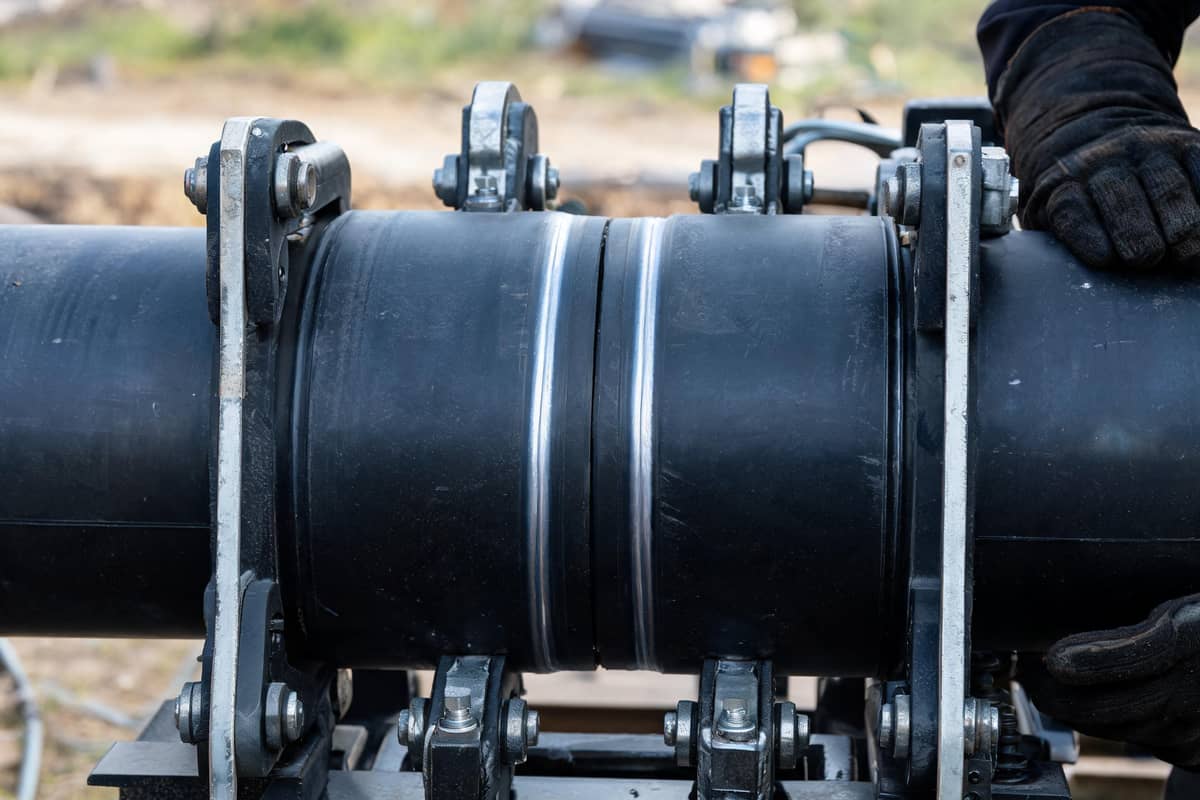
Electrofusion welding represents the highest-integrity jointing technique for natural gas distribution and critical water infrastructure crossings. In this technology, electrical resistance coils are embedded within the fitting. The automated electrofusion control box scans the fitting barcode, applies precise heating voltage and cycle duration, and melts the interface to forge a hermetically sealed joint in conformity with EN 1555-3.
Surface preparation is paramount in electrofusion jointing: the degraded outer oxide layer must be peeled with a mechanical scraper and degreased using approved isopropanol wipes. Restraining clamps must remain fastened during fusion and cooling to prevent joint misalignment. This dependable technique makes electrofusion the primary jointing specification for buried municipal gas distribution systems.
Branching with Clamp Saddles and Tapping Tees
Branch connections on existing pipelines are engineered using specialized fittings tailored to fluid type and line pressure. In water and agricultural schemes, polypropylene clamp saddles featuring corrosion-resistant galvanized bolts and elastomeric gaskets provide threaded takeoffs from 1/2" to 1" on mainline diameters from 32 to 315 mm without severing the pipe.
Conversely, in operating gas distribution networks, electrofusion tapping tees with integrated internal cutters enable live hot tapping under pressure without interrupting fluid service. Full dimensional listings and pressure ratings are published on our catalog pages. To check current pricing and confirm fitting specifications for your project, submit your items via the inquiry list or call our sales team.
Table of Contents
Caspian Sanat ZAAL
Product technical guides
These guides are based on the standards and technical data of the products themselves. Contact us to confirm the size and pressure class for your project.