
PE Pipe Welding Machines: Manual, Hydraulic or Electrofusion?
How many kinds of PE pipe welding machine there are, how manual and hydraulic butt-fusion machines differ, what an electrofusion unit is for, which machine suits which diameter, why iron welding is not advised for pressure lines, and what to ask when buying.
What is a PE pipe welding machine, and what kinds are there?
A PE pipe welding machine joins two pipe ends, or a pipe and a fitting, with controlled heat and pressure so that they cool into a single piece. Unlike compression fittings, which can be opened and closed, a welded joint is permanent and is used on water, gas and sewage main lines. The machine you need depends on the welding method and the range of pipe diameters.
There are two main methods for welding polyethylene pipe, and each needs its own machine. In butt fusion the pipe ends themselves are melted on a hot plate (heater) and pressed together. In electrofusion, a special fitting with a heating wire in its body is placed on the pipe and the machine passes the right amount of current through it.
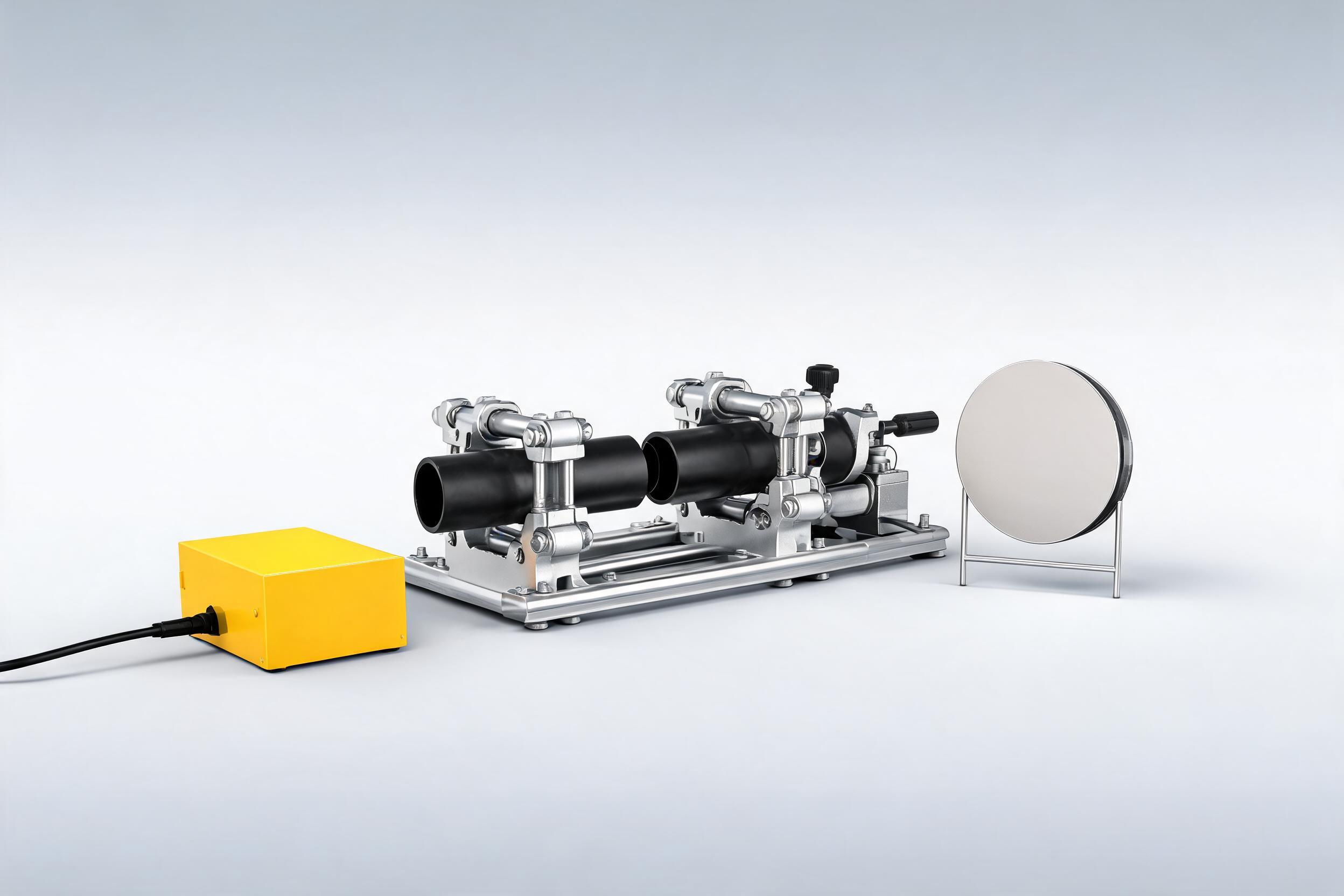
Butt-fusion machines come in two kinds: manual (mechanical), where pressure is applied with a lever, and hydraulic, where a hydraulic unit with a pressure gauge supplies it. In this guide we introduce all three kinds with the diameter ranges published in our catalogue and explain which suits which job.
Manual or hydraulic butt-fusion machine?
The manual butt-fusion machine is light and portable and works with a lever mechanism, with no hydraulic pump or oil. It usually comes with a manual or electric planer and a heater with a non-stick coating. Because it is easy to carry, it is used in narrow trenches, mountain areas, rural water supply and farm branch lines. Our catalogue lists it in two models, 20 to 63 mm and 32 to 125 mm.
The hydraulic butt-fusion machine is built for larger diameters, where the force needed to press the two ends together cannot be applied or controlled by hand. It has a hydraulic pressure unit with a gauge, an electric planer, a heater with digital temperature control and clamps with reducing inserts for different sizes. Our catalogue lists it in two models, 90 to 315 mm and 200 to 500 mm.
The general rule is simple: if most of your work is on pipe up to 125 mm and the machine must move around a lot, a manual machine is enough. If you weld main lines of 90 mm and above, especially thick, high-pressure pipe, a hydraulic machine gives more precise control of the fusion pressure. Both kinds are listed in our catalogue to ISO 12176-1.
The electrofusion machine and its fittings
An electrofusion machine does not heat the pipe itself; its job is to supply power at the right voltage and for the right time to the heating wire inside the electrofusion fitting. The usual fittings for this method are the electrofusion coupler, for joining two pipes of the same diameter, and the electrofusion tapping tee, for taking a branch from a line. The couplers in our catalogue run from 20 to 250 mm.
Electrofusion units usually read each fitting's welding data from a barcode on the fitting, set the voltage and time, and keep a record of each weld in memory for traceability. The electrofusion units in our catalogue are listed to ISO 12176-2 in three classes by the largest diameter they can weld: up to 160, up to 250 and up to 400 mm.
The main advantage of electrofusion is that the pipes do not move. That is why it is chosen for repairs on a live line, joining coils, tight spaces inside a trench and gas networks, where weld quality and records matter a great deal. On the other hand, every electrofusion joint is a separate fitting that has to be bought.
Which welding machine for which diameter?
The table below shows the published welding machine models in our catalogue with the pipe diameter range each one welds. The ranges overlap; for example, 110 mm pipe can be welded with the 32 to 125 mm manual model or the 90 to 315 mm hydraulic model. In that case the amount of work, the pipe wall thickness and transport conditions decide which is more suitable.
If a project has several sizes, choose a machine whose range covers most of the project's frequent sizes. For electrofusion you need a unit that works up to the largest electrofusion fitting in the project. Butt-fusion fittings such as elbows, tees, reducers and end caps are installed with the same butt-fusion machine.
| Machine | Method | Pipe diameter range (mm) | Reference standard |
|---|---|---|---|
| Manual butt-fusion machine, model 1 | Butt fusion | 20 to 63 | ISO 12176-1 |
| Manual butt-fusion machine, model 2 | Butt fusion | 32 to 125 | ISO 12176-1 |
| Hydraulic butt-fusion machine, model 1 | Butt fusion | 90 to 315 | ISO 12176-1 |
| Hydraulic butt-fusion machine, model 2 | Butt fusion | 200 to 500 | ISO 12176-1 |
| Electrofusion control unit | Electrofusion | Up to 160 | ISO 12176-2 |
| Electrofusion control unit | Electrofusion | Up to 250 | ISO 12176-2 |
| Electrofusion control unit | Electrofusion | Up to 400 | ISO 12176-2 |
Welding PE pipe without a machine, or with an iron
People often ask whether polyethylene pipe can be welded without a machine, or with an iron or a flame. In butt fusion, joint quality depends on three things: flat, parallel pipe end faces, an even heater temperature and controlled pressure while the ends are pressed together and cool. An iron or a flame controls none of these three, and there is no planer to square the pipe ends.
That is why hand welding with an iron is not advised for lines that work under pressure, that is water supply, pressurised irrigation and especially gas; a joint that looks sound from outside may open under pressure. If no welding machine is available, the right way on small diameters is compression fittings, which are tightened without a machine or power, and on gas lines, welding with a machine by a qualified welder.
The general steps of butt fusion
The steps of butt fusion are similar on every machine. The two pipe ends are clamped in the machine's jaws and aligned on one axis. The planer goes between the two ends and makes their faces flat and parallel. The clean heater comes between the ends and the pipe faces are heated and softened. Then the heater is removed quickly, the ends are pressed together and held that way until the joint cools.
The numbers for each step, namely heater temperature, heating time, fusion pressure and cooling time, depend on the pipe's diameter and wall thickness and on the machine, and must be read from the pipe maker's welding table and the machine's manual. We give no numbers for these steps in this article, because a wrong number can lead to a weld that opens under pressure. Leave welding on high-pressure and gas lines to a trained welder.
Buying a welding machine: what to ask
Before buying a PE pipe welding machine, settle these points: the smallest and largest diameter you weld; the method (butt fusion or electrofusion); for butt fusion, manual or hydraulic; whether the machine works at a fixed workshop or must move constantly; and whether the project is a gas network where weld records may be required.
Also ask what comes with the machine: reducing jaw inserts for different sizes, planer, heater and storage case. Send the project's butt-fusion or electrofusion fittings in the same list as the machine so that the sizes match. We give technical advice on choosing the machine and fittings before you buy; send your list from the contact page.
One more point: choose the welding machine for your future projects too, not only today's work. If you are a rural water contractor and most of your pipe is 63 to 110 mm, a manual machine with a 32 to 125 mm range covers most jobs; but if you will also work on larger transmission lines, a hydraulic machine will be needed.
Table of Contents
Caspian Sanat ZAAL
Product technical guides
These guides are based on the standards and technical data of the products themselves. Contact us to confirm the size and pressure class for your project.