
PE Pipe Clamp Saddle (Branch Saddle): Sizes, Types and Fitting
What a PE pipe clamp saddle (branch saddle) is, how a compression saddle differs from an electrofusion tapping tee, what a 1 inch or 6 inch saddle means, a table of main-pipe and outlet sizes, the fitting steps and what to state when ordering.
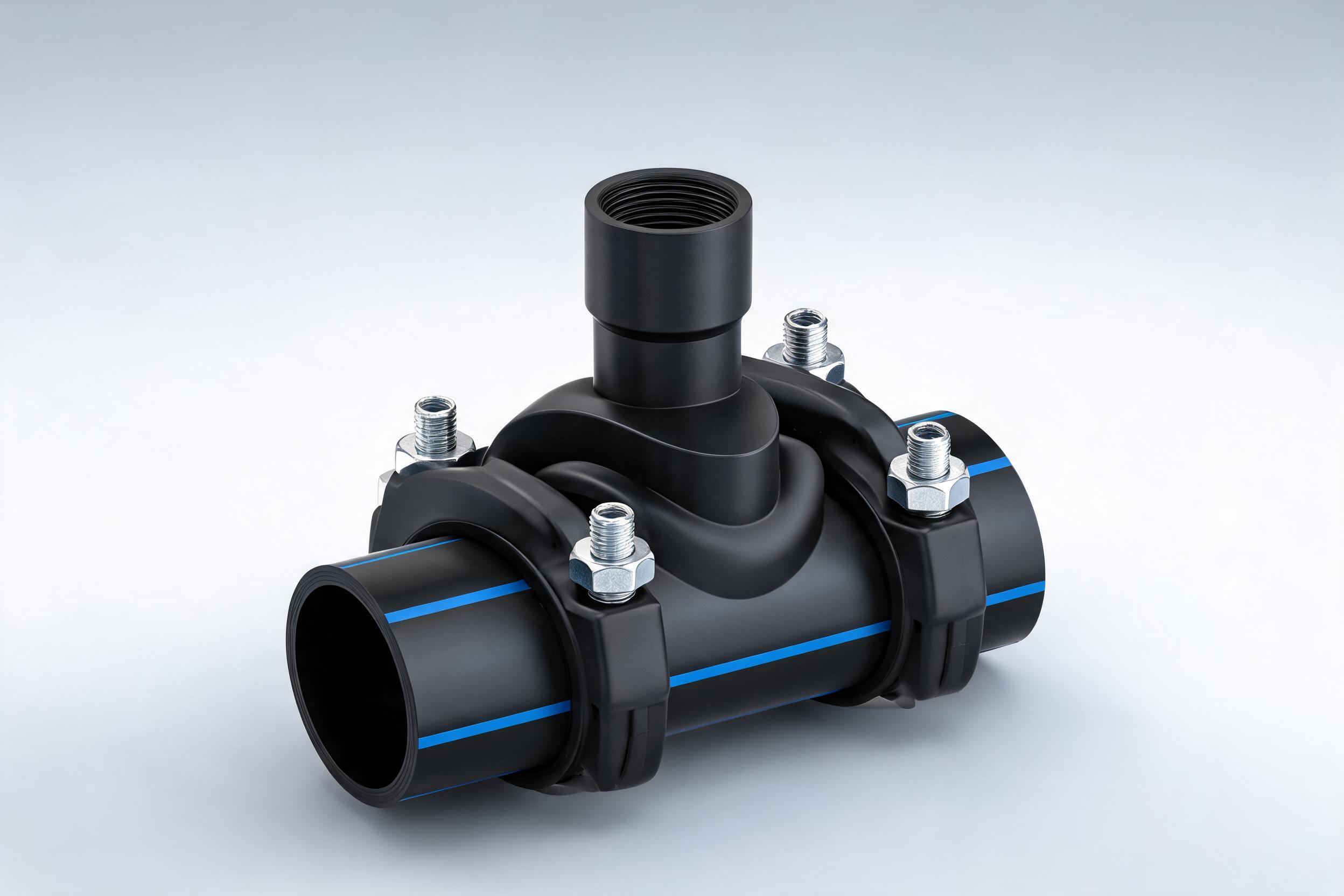
What is a PE pipe clamp saddle (branch saddle)?
A PE pipe clamp saddle, also called a branch saddle or tapping saddle, is a two-piece fitting that is clamped around a polyethylene pipe and has a threaded outlet. With it you can take a small branch from the middle of a line without cutting the pipe or fitting a tee; for example to connect a valve, a sprinkler, an irrigation sub-line or the water connection of a building.
The two halves of the saddle are bolted together, and a rubber gasket shaped to the pipe's curve seals around the branch hole. The body of the compression clamp saddle in our catalogue is polypropylene, and it is used on water supply and irrigation networks. Because it needs no welding or machine, it is one of the most used fittings in orchards and farms.
The clamp saddle is not the only way to take a branch. On gas and drinking-water networks the electrofusion tapping tee does the same job by fusion, and for larger branches a butt-fusion or compression tee is used. In this guide we explain where each one fits.
Compression saddle or electrofusion tapping tee?
The compression clamp saddle is bolted on, needs no special tool beyond a spanner and a drill, and has a threaded outlet; so a threaded valve or nipple screws straight onto it. It suits irrigation lines, farm water and water supply networks with many small branches. If the branch is no longer needed later, the outlet is closed with a threaded plug.
The electrofusion tapping tee is fused onto the main and has a built-in cutter that, after fusion, cuts through the pipe wall from inside the fitting itself. Its outlet is not threaded but a polyethylene spigot to which the branch pipe is fused. This fitting is made to EN 1555-3 for gas and drinking-water networks.
In short: for a small threaded branch on a water or irrigation line, the compression saddle is simpler and cheaper. For a gas network, or where the client specification asks for a fused joint, an electrofusion tapping tee is needed. For a branch equal or close to the main pipe diameter, a compression or butt-fusion tee is chosen.
Branch saddle sizes: main pipe × outlet
Every branch saddle is identified by two numbers: the main pipe outside diameter in millimetres and the outlet thread size in inches. In the published rows of our catalogue the compression saddle covers main pipes from 32 to 315 mm, and every main pipe size has three outlets: 1/2, 3/4 and 1 inch. The table below shows these sizes together with the market inch name for the main pipe.
For the electrofusion tapping tee, the outlet is a polyethylene diameter, not a thread. Its published rows run from 25 to 250 mm main pipe, and in each row the branch is one step smaller than the main; for example a 63 mm main with a 50 mm branch, a 110 mm main with a 90 mm branch and a 250 mm main with a 200 mm branch.
An example: if the orchard main is 90 mm (3 inch) and you want to fit a 3/4 inch threaded ball valve on it, you need a 90 mm branch saddle with a 3/4 inch outlet. If the same branch must be fused and the branch pipe is 75 mm, a 90 by 75 mm tapping tee is chosen.
| Main pipe (mm) | Market inch name | Compression saddle: thread outlet (inch) | Tapping tee: branch diameter (mm) |
|---|---|---|---|
| 25 | 3/4 | — | 20 |
| 32 | 1 | 1/2, 3/4, 1 | 25 |
| 40 | 1-1/4 | 1/2, 3/4, 1 | 32 |
| 50 | 1-1/2 | 1/2, 3/4, 1 | 40 |
| 63 | 2 | 1/2, 3/4, 1 | 50 |
| 75 | 2-1/2 | 1/2, 3/4, 1 | 63 |
| 90 | 3 | 1/2, 3/4, 1 | 75 |
| 110 | 4 | 1/2, 3/4, 1 | 90 |
| 125 | 5 | 1/2, 3/4, 1 | 110 |
| 160 | 6 | 1/2, 3/4, 1 | 125 |
| 200 | 8 | 1/2, 3/4, 1 | 160 |
| 250 | 10 | 1/2, 3/4, 1 | 200 |
| 315 | 12 | 1/2, 3/4, 1 | — |
What do a 1 inch, 4 inch and 6 inch saddle mean?
In the market, when someone says a 6 inch saddle they usually mean a saddle that fits a 6 inch main, that is 160 mm pipe. In the same way a 4 inch saddle is for 110 mm pipe and a 2 inch saddle for 63 mm pipe. These inch names are market trade names; the real size of polyethylene pipe is its outside diameter in millimetres.
But a 1 inch saddle has two meanings, and that causes ordering mistakes: it can be a saddle that fits 32 mm (1 inch) pipe, or a saddle that fits a larger pipe and has a 1 inch thread outlet. So always write both numbers separately in your order, for example a 110 mm branch saddle with a 3/4 inch outlet.
Another point is that the compression saddle's outlet is a female thread; the piece screwed into it needs a male thread of the same size. If you want to take a polyethylene sub-line from the saddle outlet, you need a thread-to-polyethylene adaptor between the saddle and the pipe; put that on your shopping list too.
How to fit a branch saddle on polyethylene pipe
Choose a straight, clean part of the pipe for the saddle, away from welds and other fittings. Clean soil and mud off the pipe surface and make sure the rubber gasket is undamaged and seated correctly in the upper half of the saddle. Place the upper half on the pipe so that the outlet faces the direction you want, and fit the lower half from below.
Tighten the bolts crosswise and a little at a time so that the pressure on the gasket is even and the saddle does not tilt; tightening one bolt fully before moving to the next squeezes the gasket on one side. After the saddle is closed, drill the pipe wall through the outlet with a suitable drill and pull out the shavings so they do not enter the line.
On a line under pressure, drill only with a tool and method made for tapping under pressure, or take the pressure off the line before the work. Read the hole diameter, bolt torque and exact fitting procedure from the saddle maker's instructions. On urban networks, branching from a water or gas line is done with a permit and under the supervision of the local water or gas company.
Branch saddles in orchard and farm piping
In orchard and farm irrigation, the polyethylene main or sub-main usually runs along the field, and a branch is needed at the head of each row or block. Here the compression clamp saddle is the most used fitting: it is clamped onto the sub-main, a ball valve or adaptor goes on its outlet, and water flows from there into that row's lateral tubing or drip tape.
The advantage of a saddle in this use is that if a new row is added later, or a branch has to move, a new branch can be taken without cutting and welding the main. For small row outlets a 1/2 or 3/4 inch outlet is common, and for blocks that need more water a 1 inch outlet. Our orchard piping guide explains the whole chain of this system, from the well to the foot of the tree.
What to state when ordering branch saddles
Put these in your enquiry: the main pipe outside diameter in millimetres; the outlet thread size in inches (1/2, 3/4 or 1); the kind of line (irrigation, water supply or gas) so that the right choice is made between a compression saddle and an electrofusion tapping tee; for a tapping tee, the branch pipe diameter; and the quantity. If you know the main pipe's pressure class, give it as well.
On irrigation projects with many branches, count the saddles from the plan and allow a few extra for repairs and future extensions. Put the ball valves, plugs and sub-line pipe in the same list so that the sizes match. We give technical advice on choosing saddles and sizes before you buy; send your list from the contact page.
Table of Contents
Caspian Sanat ZAAL
Product technical guides
These guides are based on the standards and technical data of the products themselves. Contact us to confirm the size and pressure class for your project.