
Differences Between PE Gas and Water Pipe: Standards & Specs
Expert guide examining structural differences, manufacturing standards, and safety requirements between polyethylene natural gas distribution networks and potable water mains.
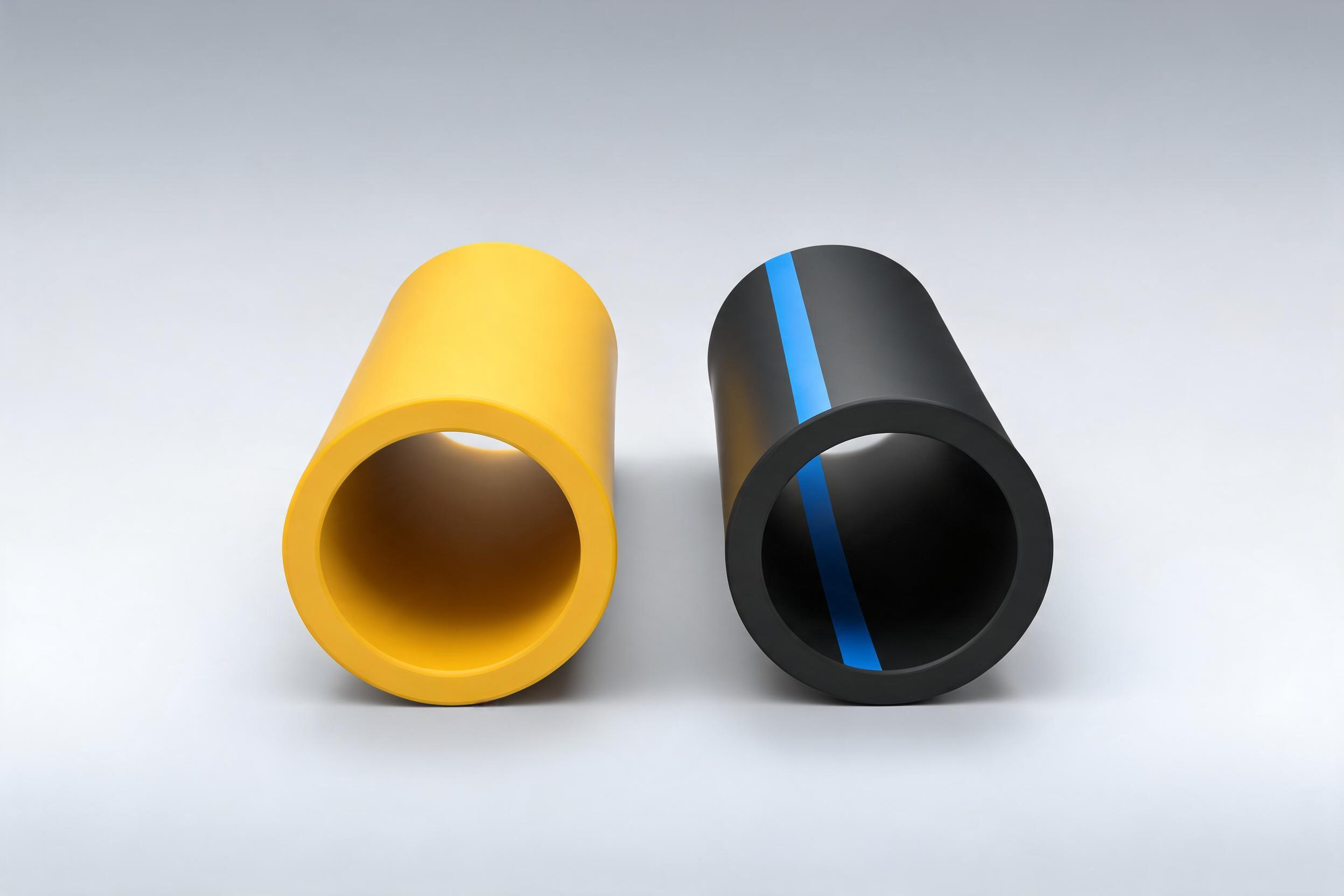
Overview and Applications: Water vs Gas Pipes at a Glance
Polyethylene PE100 water pressure pipe is one of the most widely used pressure pipes in municipal and rural water supply, water transmission mains, pressurized irrigation, and industrial applications. The number 100 designates a Minimum Required Strength (MRS) of 10 MPa, meaning the raw polymer is engineered to sustain this hydrostatic stress over long-term operation at 20 °C. These pipes are classified by outside diameter and dimension ratio, deployed from OD 16 to 630 mm across water supply schemes.
In contrast, polyethylene gas distribution pipe is specifically engineered for buried natural gas distribution networks in urban streets, industrial parks, and residential service connections. Because gas is flammable and gas networks run through inhabited areas, gas distribution networks are installed under special supervisory rules and the pipe is not used for other applications. Gas pipes are supplied across outside diameters from 25 to 225 mm and are buried underground for maximum safety.
Color Coding and Visual Identification in the Trench
The primary visual distinction on site and inside buried trenches is body color and co-extruded longitudinal stripes. Water pressure pipes feature a solid black body with longitudinal blue stripes running down their entire length. This standardized color coding prevents accidental confusion between drinking water lines and sewer or industrial conduits during future excavations. Black pipe is protected against the sun's ultraviolet radiation by the carbon black (soot) in its compound, typically around 2 to 2.5 percent by weight.
Conversely, gas distribution pipes are manufactured with either a solid yellow body or a black body with distinctive yellow longitudinal stripes, serving as an immediate hazard indicator. Yellow pipes are more sensitive to sunlight degradation than black carbon-stabilized pipes; they must be kept under covered storage and shielded from protracted direct solar exposure before laying. Installing yellow warning tape above the pipeline in the trench is also mandatory.
Reference Standards and Quality Codes for Water and Gas
Water supply polyethylene pipes are manufactured in compliance with international standards ISO 4427 and EN 12201-2. These standards regulate dimensional tolerances, organoleptic and hygienic compliance for human drinking water contact, hydrostatic testing at 20 °C, and system jointing integrity.
In contrast, gas pipes conform to specialized international gas specifications ISO 4437 and EN 1555-2, and within Iran they must follow the technical requirements of the National Iranian Gas Company (IGS standards). Supply to gas distribution projects typically requires the gas company's approval of the manufacturer, and the gas inspector asks for the manufacturer's approval documents.
SDR Dimension Series and Pressure Rating Differences
The Standard Dimension Ratio (SDR) defines the ratio of outside diameter to wall thickness. Water pipes span an extensive range of dimension ratios from SDR 41 to SDR 7.4, covering nominal pressure ratings from PN4 to PN25 based on an 8.0 MPa design stress in PE100; for instance, SDR 17 corresponds to PN10, SDR 11 to PN16, and SDR 7.4 to PN25. This diversity enables hydraulic designers to optimize wall thickness from low-pressure gravity mains up to high-head pumping systems.
Unlike the diverse SDR options available for water lines, gas pipes in our catalog are supplied exclusively in the SDR 11 dimension series across PE80 and PE100 grades. Note that the allowable operating pressure in a gas pipeline is lower than the nominal hydrostatic pressure (PN) of the same pipe in water service, because a higher design safety factor applies to gas and the maximum pressure is set by the gas company's rules.
Jointing Methods, Handling and Comprehensive Comparison Table
Jointing methodologies reflect the differing risk levels between the two media. In natural gas networks, electrofusion fittings are given priority, and butt fusion is carried out only by certified welders. In water supply networks, in addition to butt fusion and electrofusion, mechanical compression fittings are widely used for smaller diameters up to 110 mm. Water pipes are supplied in 100 m and 200 m coils for small sizes and 6 m and 12 m straight bars for larger diameters.
The table below provides a comprehensive summary of technical specifications, color coding, and standards governing water and gas pipes in the catalog. Reviewing these distinctions helps engineers and contractors avoid material selection errors in underground utility projects and match their choice to the project's engineering calculations.
| Technical Property | Water Pipe (P001) | Gas Pipe (P003) |
|---|---|---|
| Pipe Color & Identification Stripe | Black with blue longitudinal stripe | Solid yellow or black with yellow stripe |
| Reference Standards | ISO 4427 / EN 12201-2 | ISO 4437 / EN 1555-2 / IGS |
| Raw Material Grades | PE80 and PE100 | PE80 and PE100 |
| Standard Dimension Ratio (SDR) | SDR 41 to SDR 7.4 | Exclusively SDR 11 |
| Nominal Water Pressure (PN) | PN4 to PN25 (at 20 °C) | Governed by gas safety codes |
| Approved Jointing Methods | Butt fusion, compression, electrofusion | Electrofusion, certified butt fusion |
Table of Contents
Caspian Sanat ZAAL
Product technical guides
These guides are based on the standards and technical data of the products themselves. Contact us to confirm the size and pressure class for your project.