
PE Well Casing Pipe: Sizes, Wall Thickness, Weight and Installation
What PE well casing pipe is, its advantages over metal casing, a table of 110 to 500 mm diameters with three wall thicknesses and weight per metre, choosing diameter and wall by pump and depth, bar length, installation and what to state when ordering.
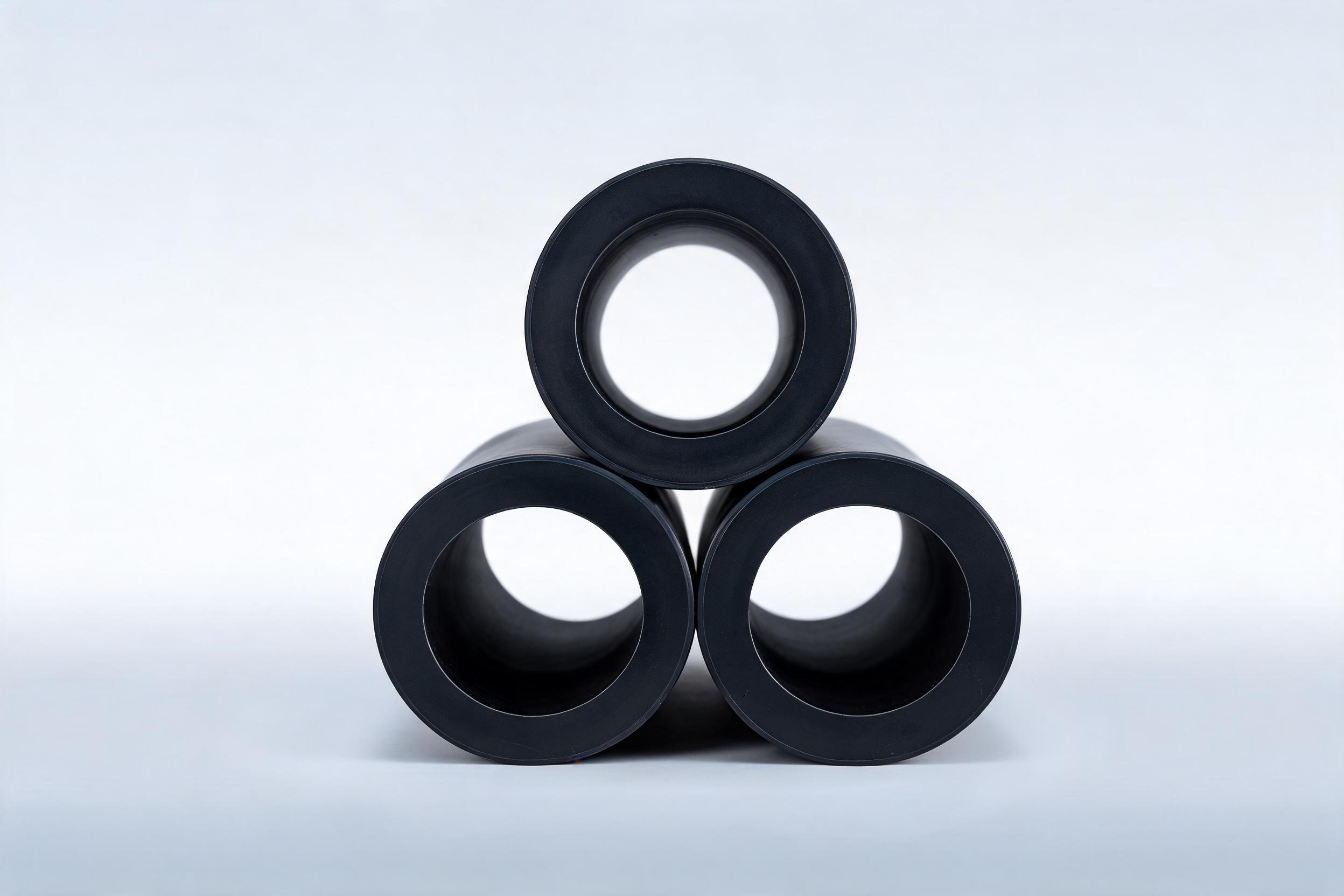
What is PE well casing pipe?
PE well casing pipe is the pipe placed inside a well after drilling to hold up the well wall, so that soil and rock do not collapse and the path for the pump and riser stays open. Agricultural, drinking and industrial water wells without suitable casing deteriorate over time; the casing is the permanent skeleton of the well.
The polyethylene well casing that Caspian Sanat ZAAL supplies is plain, without slots. That means its wall is continuous with no openings, and it comes in 6 and 12 m bars. It is listed in our catalogue as product P007, and its published diameters run from 110 to 500 mm, each diameter in three wall thicknesses.
In this guide we explain the advantages of polyethylene casing over metal casing, the full table of diameter, wall and weight, how to choose diameter and wall, bar length and estimating load weight, installation notes and the order checklist. The final choice must always be made with a drilling specialist and according to the geology of that particular well.
Is PE or metal casing better?
The most important advantage of polyethylene casing is that it does not rust. Metal casing corrodes and decays over time in saline, acidic or aggressive water, and rust particles get into the well water; polyethylene does not corrode in the same conditions and adds no rust to the water. This matters a great deal where groundwater is saline.
The second advantage is lower weight. A polyethylene bar is lighter than metal casing of the same size, which makes transport to the well, handling on site and lowering the bars into the well simpler. The smooth inner surface also collects less scale, so water flow and pump movement inside it are smoother.
On the other hand, the choice between polyethylene and metal casing does not depend on these two advantages alone. Well depth, drilling diameter, the ground layers, the pressure of the surrounding soil and water and the drilling method all affect the decision. So the short answer is: polyethylene casing is a suitable choice for many wells, but make the final decision with a drilling specialist.
PE well casing size table: diameter, wall and weight
The table below shows every published diameter of our polyethylene well casing. Each diameter has three wall thicknesses, and the weight per metre is given in the same order as the walls; for example, 200 mm pipe comes with an 11.8, 14.8 or 18.2 mm wall and weighs 6.663, 8.223 or 9.927 kg/m. All rows come in 6 and 12 m bars.
The inch column is the usual market trade name for that diameter, and for 140 and 180 mm there is no inch name the sources agree on. The real size of polyethylene pipe is always its outside diameter in millimetres; use that millimetre figure when ordering and when comparing with the drilling diameter.
| Outside diameter (mm) | Market inch name | Wall thickness (mm) | Weight per metre (kg) |
|---|---|---|---|
| 110 | 4 | 6.5, 8.1, 10 | 2.018, 2.476, 3 |
| 125 | 5 | 7.4, 9.2, 11.4 | 2.611, 3.196, 3.885 |
| 140 | — | 8.3, 10.3, 12.8 | 3.28, 4.008, 4.885 |
| 160 | 6 | 9.5, 11.8, 14.6 | 4.29, 5.247, 6.369 |
| 180 | — | 10.6, 13.3, 16.4 | 5.387, 6.652, 8.05 |
| 200 | 8 | 11.8, 14.8, 18.2 | 6.663, 8.223, 9.927 |
| 225 | 9 | 13.3, 16.6, 20.5 | 8.447, 10.379, 12.578 |
| 250 | 10 | 14.8, 18.4, 22.8 | 10.444, 12.785, 15.542 |
| 280 | 11 | 16.5, 20.6, 25.5 | 13.044, 16.032, 19.471 |
| 315 | 12 | 18.6, 23.2, 28.7 | 16.54, 20.311, 24.652 |
| 355 | 14 | 20.9, 26.2, 32.3 | 20.95, 25.846, 31.272 |
| 400 | 16 | 23.6, 29.5, 36.4 | 26.651, 32.792, 39.708 |
| 450 | 18 | 26.5, 33.1, 41 | 33.671, 41.401, 50.311 |
| 500 | 20 | 29.5, 36.8, 45.5 | 41.642, 51.141, 62.044 |
How to choose the diameter and wall of well casing
The casing diameter is chosen by the drilling diameter and the pump size. The submersible pump must go down and come up inside the casing with enough clearance, so the casing inside diameter, which is the outside diameter minus twice the wall thickness, must be larger than the pump with its cable and riser. On the other side, the casing outside diameter must fit inside the drilled borehole and leave room for the filter gravel around it.
The wall thickness is set by the well depth and the pressure of the surrounding soil and water. The main criterion is the casing's resistance to the external pressure that tries to crush the pipe; the deeper the well, the higher this pressure and the thicker the wall needed. That is why each diameter in the table has three walls.
Note that a thicker wall reduces the inside diameter. For example, 200 mm pipe with an 18.2 mm wall has an inside diameter of about 163.6 mm, and with an 11.8 mm wall about 176.4 mm. If the pump only just fits, this difference is decisive; put the depth, drilling diameter and pump diameter together in your enquiry so that a suitable combination is offered.
Bar length and estimating the casing load weight
PE well casing comes in 6 and 12 m bars. To estimate the number of bars, divide the casing depth by the bar length and round up; for example, 120 m of casing needs 10 bars of 12 m or 20 bars of 6 m. A 12 m bar has fewer joints, and a 6 m bar is easier to transport and handle.
Get the weight of each bar by multiplying the weight per metre by the bar length. For example, a 12 m bar of 200 mm pipe with a 14.8 mm wall at 8.223 kg/m weighs about 98.7 kg. This figure helps plan transport, choose the lifting equipment and estimate freight cost.
How to install PE well casing
The casing bars are joined to each other before going into the well and are lowered slowly and on one axis. Keeping the bars aligned matters, because casing that tilts or bends in the well makes lowering the pump difficult later. The method of joining the bars is agreed in the enquiry according to the diameter, depth and the drilling contractor's equipment.
After the casing is installed, the space between the casing and the well wall is filled with filter gravel. Because our casing has no slots, the design of the water-entry section of the well, and the position and type of its screen or perforated pipe, is set by the drilling specialist according to the water-bearing layers. During transport and storage, stack the bars on a flat surface and do not drag them over rocks or rough ground.
Common mistakes when buying well casing
The first mistake is choosing casing by outside diameter alone. Two pipes of the same diameter with different walls have different inside diameters, and if the thickest wall is chosen, the planned pump may not fit inside it. Before buying, work out the inside diameter from the table with the simple formula of outside diameter minus twice the wall, and compare it with the pump diameter.
The second mistake is choosing the thinnest wall in a deep well to save cost; casing that cannot withstand the pressure of the surrounding soil and water may deform and trap the pump. The third mistake is ordering without stating the bar length and quantity, which leaves too much or too little casing on site. All three are avoided by giving the depth, drilling diameter, pump diameter and bar length in your enquiry.
What to state when ordering well casing
Put these in your enquiry: the well depth and the casing length; the drilling diameter; the diameter of the submersible pump that will go inside the casing; the outside diameter and wall thickness if the drilling specialist has set them; the bar length, 6 or 12 m; and the number of bars or the total length. If the well is in another city, give the destination as well; delivery to other cities is available.
We give technical advice on choosing casing diameter and wall before you buy, but setting the wall for deep wells and unstable ground needs the drilling specialist's calculation and experience. You can also put polyethylene water pipe for the line from the wellhead to the orchard in the same list. Send the list through the contact page and a pro-forma invoice will be prepared.
Table of Contents
Caspian Sanat ZAAL
Product technical guides
These guides are based on the standards and technical data of the products themselves. Contact us to confirm the size and pressure class for your project.