
PE Cable Duct Pipe: Power Conduit, Duct and Double-Wall Cable Pipe
What PE cable duct pipe (power conduit) is, how solid-wall, single-wall corrugated and double-wall cable pipe differ, sizes from 40 to 200 mm with wall and weight, coils or bars, a real Tavanir project and what to state when ordering.
What is PE cable duct pipe and what is it for?
PE cable duct pipe, also known in the market as power conduit, cable duct or cable protection pipe, is the pipe through which low- and medium-voltage power cables, street lighting, control and telecom cables run underground. Its job is not to carry a fluid; its job is to keep a safe, empty path for the cable inside the ground.
The pipe protects the cable from spades and digging tools, soil pressure, moisture and groundwater. Another important benefit is that if a cable is ever damaged, or a new cable has to be added, the cable is pulled out of the pipe or a new one is pulled through it, and the whole route does not have to be dug up again.
Polyethylene is electrically insulating, does not rust and lasts well in wet and saline soils. That is why PE cable duct is used in urban and rural power distribution, street lighting, industrial sites and telecom projects. Caspian Sanat ZAAL's cable duct appears in the catalogue as product P010.
Three kinds of power conduit: solid wall, flexible and double-wall
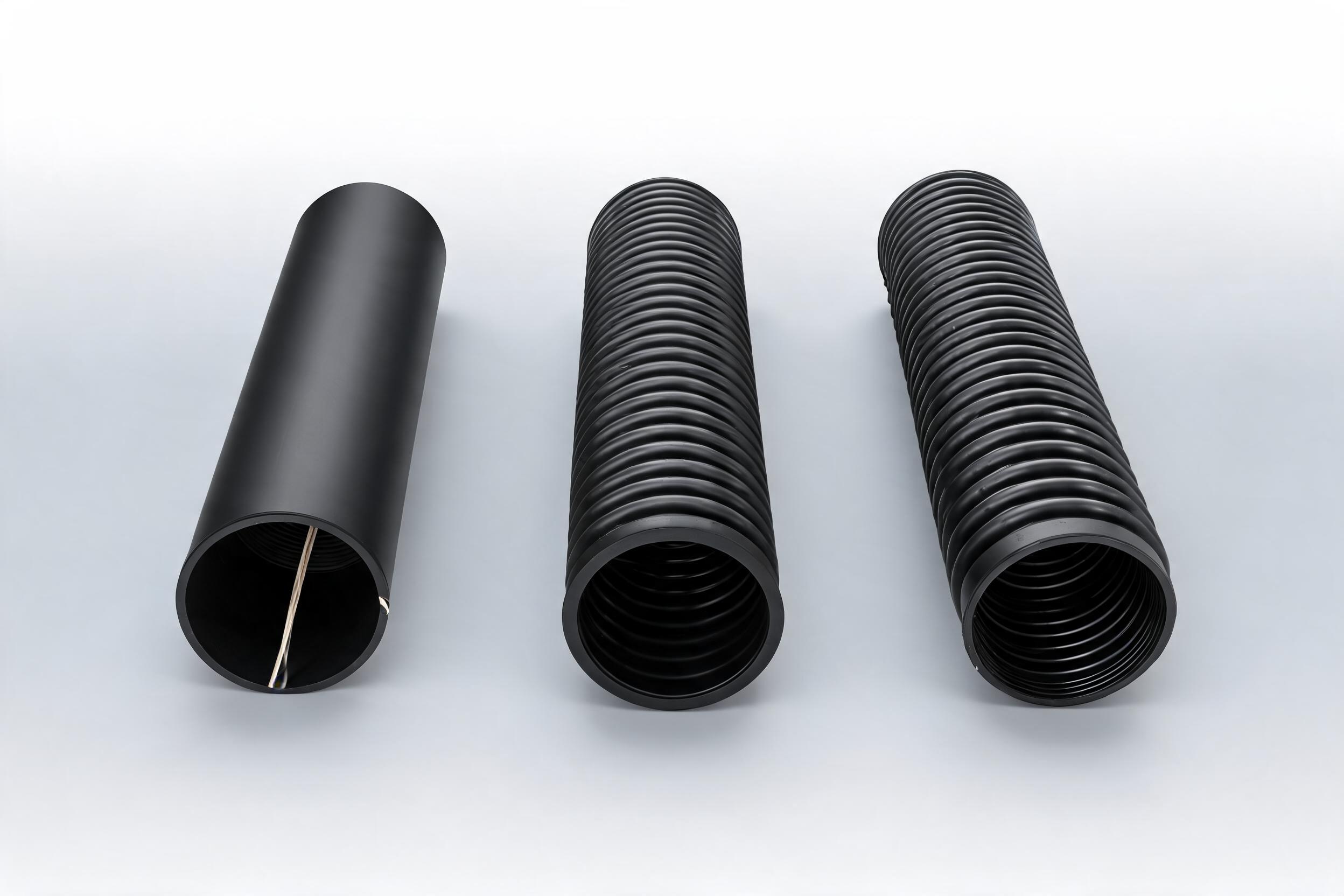
Cable duct comes in three constructions. Solid-wall duct has a single uniform wall, much like water pipe, and is chosen for long straight runs where the cable must be pulled over a long distance. Its smooth inner surface makes pulling easy, and its wall thickness is fixed for each size.
Single-wall corrugated duct, which the market also calls flexible power conduit, has a ribbed wall and is very flexible. It suits winding routes and cable entries into buildings, panels and pits, because it bends around obstacles without extra fittings.
Double-wall corrugated duct, or double-wall cable pipe, has two walls: a ribbed outer wall that carries the soil load and a smooth inner wall that the cable slides through easily. It is used on urban routes and under roads. Where the route passes under a street or a vehicle crossing, double-wall duct is the usual choice.
Double-wall cable pipe is also used for telecom cables, and in our range it has taken the place of telecom subduct. The choice between the three constructions depends on the route: many bends point to flexible duct, traffic load to double-wall, and a long straight route with a long pull to solid wall. If you are not sure, describe the route to us.
PE cable duct sizes: wall, weight and supply form
The published cable duct sizes in our catalogue run from 40 to 200 mm. Solid-wall duct is listed from 40 to 160 mm with its wall thickness and weight, single-wall corrugated from 50 to 160 mm and double-wall from 90 to 200 mm. The table below shows the wall thickness and weight per metre of solid-wall duct, together with the constructions available in each size.
Diameters from 40 to 110 mm are supplied in coils of 50, 100 and 200 m, and from 63 mm upward there is also a 6 m bar; sizes of 125 mm and larger come in bars only. Coils are easier for long runs with few joints, and bars for short runs, trenches and places where a large coil is hard to handle.
The weight per metre in the table helps estimate the load weight and transport cost: for example, a 100 m coil of 110 mm solid-wall cable duct at 2.018 kg/m weighs about 201.8 kg. For other sizes and lengths you can use the site's PE pipe weight calculator, or multiply the weight per metre by the total length.
| Diameter (mm) | Market inch name | Solid-wall thickness (mm) | Solid-wall weight (kg/m) | Constructions | Supply form |
|---|---|---|---|---|---|
| 40 | 1-1/4 | 2.4 | 0.271 | Solid wall | Coil 50, 100, 200 m |
| 50 | 1-1/2 | 3 | 0.423 | Solid wall, flexible | Coil 50, 100, 200 m |
| 63 | 2 | 3.8 | 0.675 | Solid wall, flexible | Coil or 6 m bar |
| 75 | 2-1/2 | 4.5 | 0.952 | Solid wall, flexible | Coil or 6 m bar |
| 90 | 3 | 5.3 | 1.347 | Solid wall, flexible, double-wall | Coil or 6 m bar |
| 110 | 4 | 6.5 | 2.018 | Solid wall, flexible, double-wall | Coil or 6 m bar |
| 125 | 5 | 7.4 | 2.611 | Solid wall, flexible, double-wall | 6 m bar |
| 160 | 6 | 9.5 | 4.29 | Solid wall, flexible, double-wall | 6 m bar |
| 200 | 8 | — | — | Double-wall | 6 m bar |
How cable duct differs from PE water pipe
Water pipe is made to hold internal water pressure, so it is sold by pressure class, such as 6, 10 or 16 bar, and by SDR. Cable duct has no internal pressure; its job is to carry the soil load from outside and keep the cable path open. That is why no pressure class is recorded in the published rows of our cable duct, and the pipe is identified by diameter, wall thickness and construction.
In practice a solid-wall pipe with a stated pressure class is sometimes used for a cable route too, as the example in the next section shows. But if you need a line for water or irrigation, do not use cable duct in place of water pipe; use water pipe with the pressure class the line needs.
A real example: conduit with a pull cord for a Tavanir project
Caspian Sanat ZAAL's only reference project is the Tavanir project in Isfahan province. One item was supplied for it: polyethylene power conduit with a pull cord, that is cable duct with a pulling cord already inside, in size 110 mm and 6 atm. The cord inside the pipe is used later to pull the cable through, which makes cabling simpler on long routes.
This example shows that ordering cable duct is not just asking for a power pipe; the diameter, pressure or wall thickness, whether a pull cord is needed and the supply form all belong in the order. If your project has a client specification, copy it into your enquiry word for word so that matching goods are supplied.
Installing underground power conduit: practical notes
The trench floor for cable duct must be flat and compacted so that the pipe does not sag along the route; sags and bumps make the cable snag while it is being pulled or damage its sheath. Lay the duct on a stone-free sand bed and do not let rocks or building rubble fall onto it.
Lay electrical warning tape above the duct so that anyone digging along that route years later notices the cable before reaching the pipe. Backfill in layers rather than all at once. Cap the pipe ends until the cable is pulled, so that soil, water and animals stay out, and if the duct has no pull cord, leave a draw rope inside it.
Coiled duct reduces the number of intermediate joints because of its continuous length, and suits long routes better. Bars are joined, or a line is repaired, with a coupler made for that construction, and the coupler type is agreed when you send your enquiry. Keep the clearances from water and gas pipes and other utilities that the power distribution company requires.
What to state when ordering cable duct
Put these in your enquiry: the pipe outside diameter in millimetres; the construction (solid wall, flexible or double-wall); any wall thickness or pressure class the client specification asks for; the supply form (50, 100 or 200 m coil, or bars); the total length; and whether a pull cord is needed. To choose the diameter, also give the diameter and number of cables that will run through each duct.
The duct must let the cable be pulled without snagging and leave room for extra cables in future. Burial depth, spacing from other cables and trench details are set by the local power distribution company's rules and the project specification; agree them with the supervising engineer or the power company. We give technical advice on construction and size before you buy, and receive your list through the contact page.
Table of Contents
Caspian Sanat ZAAL
Product technical guides
These guides are based on the standards and technical data of the products themselves. Contact us to confirm the size and pressure class for your project.