
What is Corrugated Pipe? Structure & Ring Stiffness (SN)
Technical guide to double-wall corrugated sewer pipes, comparing solid-wall sewer pipe and explaining how it differs from drainage pipe, SN4 to SN16 classes, and trench installation.
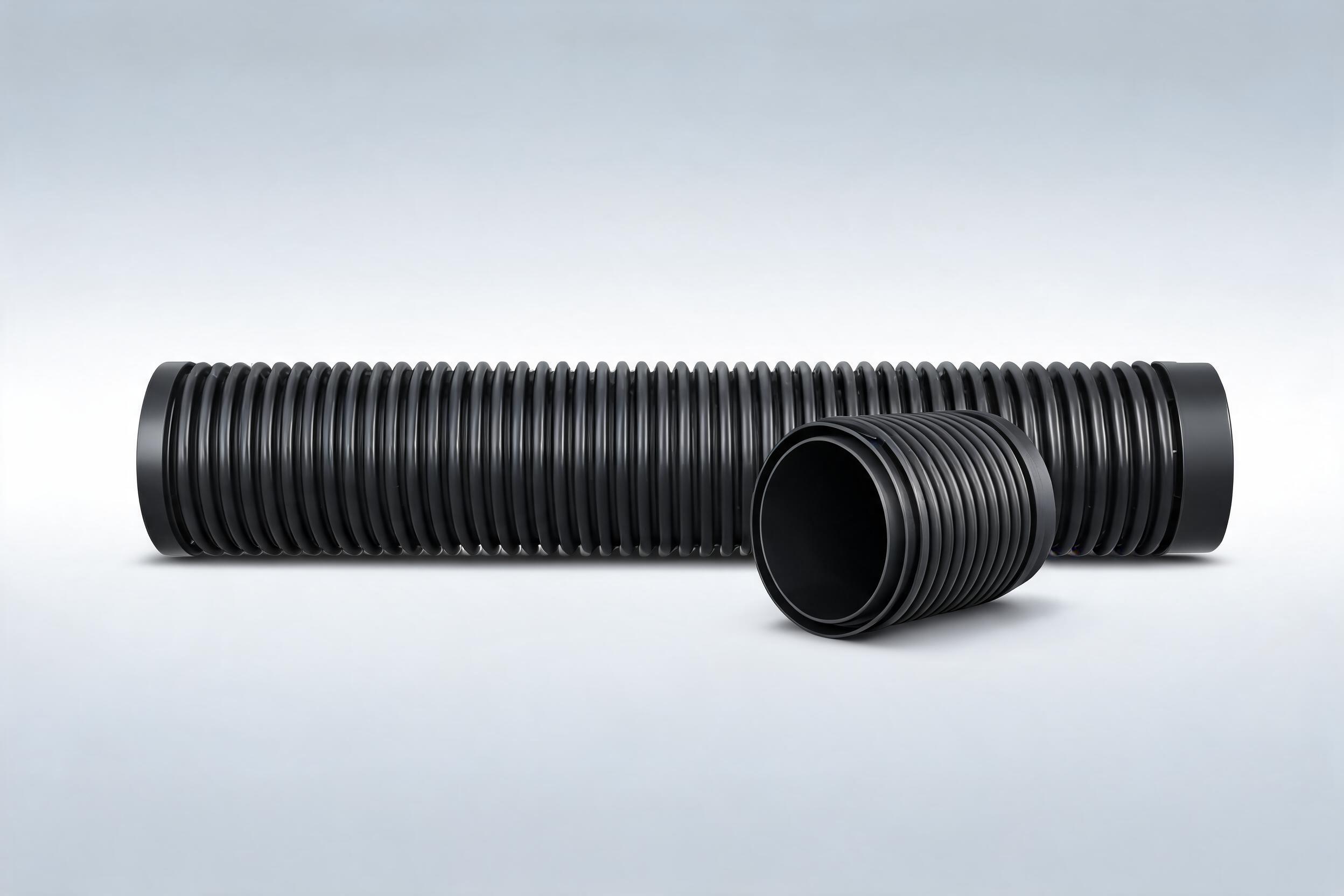
What is Corrugated Pipe and How is it Structured?
Corrugated pipe is a polyethylene pipe with a ribbed outer wall, used for gravity (non-pressure) transport of sewage and storm water. Double-wall corrugated pipe is manufactured from two polyethylene layers extruded and fused together simultaneously. The smooth interior layer possesses minimal roughness, ensuring unimpeded gravity flow for sewage and industrial effluent while preventing sediment buildup. Conversely, the corrugated or profiled outer wall provides the necessary ring stiffness to endure overburden soil and traffic loads with less raw material and lower overall weight.
These pipes are specifically designed for municipal and industrial gravity sewer collection networks, stormwater transmission lines, highway drainage, and culverts, conforming to EN 13476-3 and ISO 21138 standards. Corrugated pipe is engineered for non-pressure gravity flow and is not suitable for pressurized lines; hydraulic engineering calculations must therefore never assume internal working pressure. The low weight of corrugated sections makes handling and installation in the trench easier.
Comparison: Corrugated vs Solid-Wall Sewer & Drainage Pipes
In wastewater networks, solid-wall polyethylene sewer pipe serves alongside double-wall corrugated pipe. Solid-wall sewer pipe features a smooth, solid wall dimensioned to EN 12666 and ISO 4427 in diameters from 110 to 1200 mm and SDR 26, 33, and 41 series. The fundamental difference lies in jointing: solid-wall pipes are butt-fused into a continuous, homogeneous line, making them ideal for high groundwater, river and road crossings, or unstable soils where sewage leakage cannot be tolerated.
Corrugated pipe is not drainage pipe. Drainage pipe is a separate product, supplied in straight lengths, that collects excess soil water under green spaces through openings in its wall and carries it to an outlet, whereas double-wall corrugated pipe is built to carry sewage and storm water by gravity.
Ring Stiffness Classes (SN) and Engineering Selection
Ring stiffness expresses the pipe's resistance to deflection under soil and surface loads, in kN/m²; SN8 means a ring stiffness of 8 kN/m². A higher class resists greater structural loads. The corrugated external profile provides high vertical load resistance, enabling the flexible pipeline to deflect slightly without cracking, mobilizing the load-bearing capacity of the surrounding soil envelope. This flexible behavior prevents catastrophic brittle pipe failure under uneven soil settlement.
As a general guide, SN4 suits shallow cover without traffic, SN8 most urban municipal streets, and SN16 deep burial or heavy traffic. The final choice depends on cover depth, soil type, groundwater, traffic load and compaction quality, and should follow the designer's calculations. Inadequate stiffness selection can result in excessive deflection exceeding regulatory limits in the trench; assessment of static earth loads and dynamic axle loads is essential prior to purchase.
Jointing Methods, Gaskets and Trench Installation
Pipes are joined with a socket and rubber sealing ring. Place the ring in the correct corrugation on the spigot, apply the specified lubricant and push the spigot fully and straight into the socket. The joint is fast and needs no welding machine. This rapid assembly is an operational advantage in crowded urban projects where open trenches cause traffic disruptions.
Prepare the trench bed with uniform granular material and check the design gradient. Compact the surround in thin layers, evenly on both sides; the performance of flexible pipe depends on surround compaction. Pipes are supplied in 6 m bars, and their low weight makes handling easy.
Catalog Specifications Table for Sewer and Drainage Products
Double-wall corrugated pipe is sized by inside diameter (ID), from 150 to 1200 mm, because hydraulic capacity depends on the bore. In contrast, solid-wall sewer pipes are dimensioned by outside diameter (OD) from 110 to 1200 mm across PE80 and PE100 grades. The table below outlines the technical specifications of sewer and drainage products from the Caspian Sanat ZAAL catalog, enabling engineers to match options to site specifications.
To accurately select pipe specifications and estimate quantities in sewer and stormwater transmission projects, design engineers can use our online simulator and inquiry forms. Cross-referencing inside diameter and hydraulic gradient prior to procurement helps prevent field execution problems in gravity drainage schemes.
| Product | Reference Standard | Size Range (mm) | Stiffness Class / SDR | Jointing & Supply |
|---|---|---|---|---|
| Double-Wall Corrugated Sewer Pipe (P004) | EN 13476-3 / ISO 21138 | Inside diameter 150 to 1200 | SN4, SN8, SN16 | Socket with rubber sealing ring (6 m bars) |
| Solid-Wall PE Sewer Pipe (P005) | EN 12666 / ISO 4427 | Outside diameter 110 to 1200 | SDR 26, 33, 41 (PE80, PE100) | Butt fusion (6 m and 12 m bars) |
Table of Contents
Caspian Sanat ZAAL
Product technical guides
These guides are based on the standards and technical data of the products themselves. Contact us to confirm the size and pressure class for your project.