
What is Polyethylene Pipe? Grades, Pressure Ratings & Uses
Comprehensive guide to polyethylene pipe specifications, PE100 vs PE80 grades, pressure class analysis, and the 5 main application families in water, gas, and sewage projects.
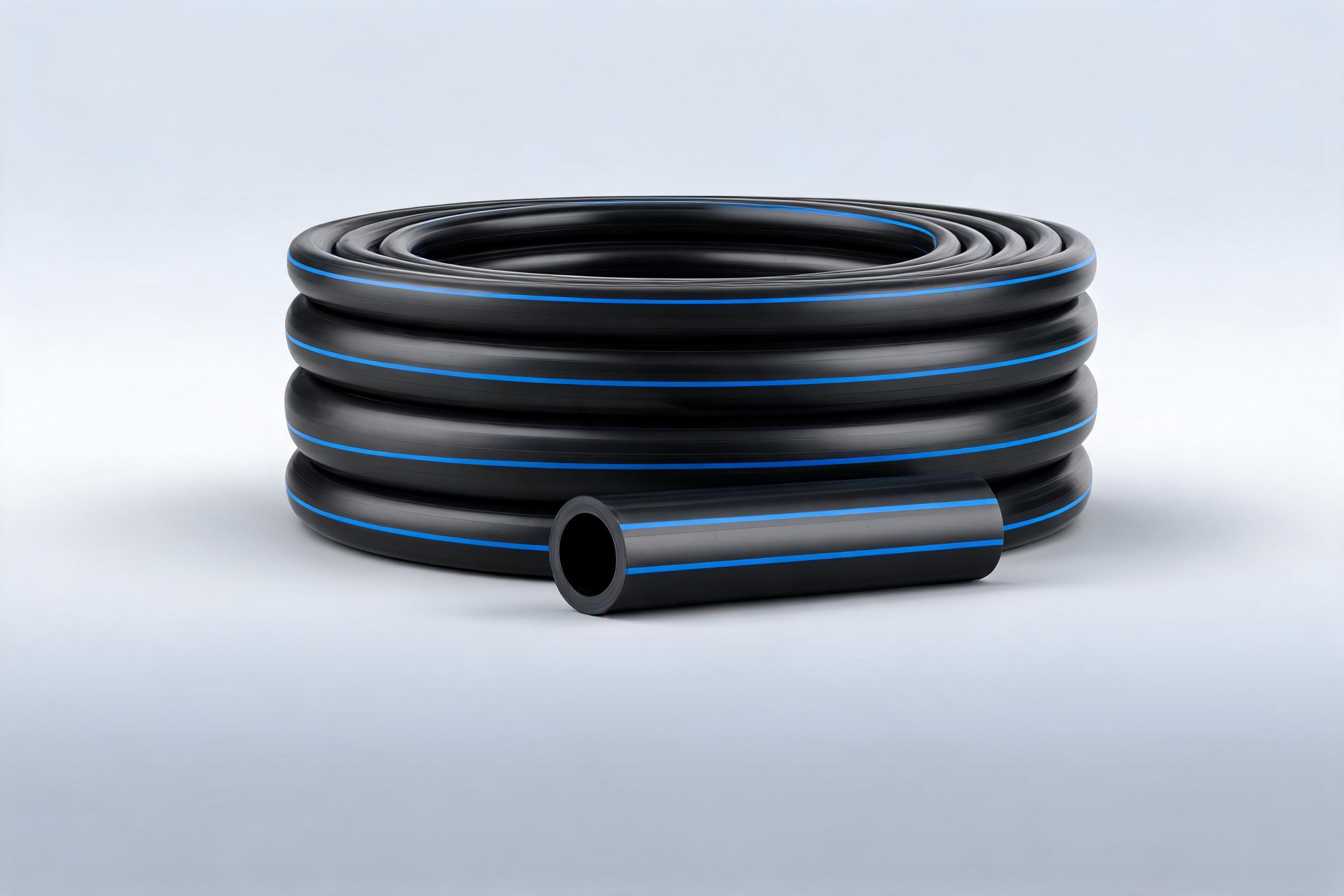
Introduction: What is Polyethylene Pipe?
Polyethylene is a thermoplastic polymer with a chain structure that has found a special place in the piping industry due to its light weight, toughness, and resistance to corrosive materials. These pipes are classified and named based on their minimum required strength at 20 °C. Their polymeric structure resists acidic corrosion, scaling, and UV rays; in black pipes, the carbon black (soot) in the compound, typically around 2 to 2.5 percent by weight, protects the pipe against the sun's ultraviolet radiation.
Black polyethylene pipes do not depend on external anti-rust coatings, which is a major advantage of this material in wet environments and corrosive soils. The flexibility of polyethylene dampens water hammer and absorbs asymmetric soil settlements without breaking, which improves the safety of transmission lines.
Structural Grade Technical Comparison: PE100 vs PE80
The naming of polyethylene pipe grades indicates the inherent strength of the raw materials. The PE100 grade has a Minimum Required Strength (MRS) of 10 MPa, while this value for the PE80 grade is 8 MPa. This difference in hydrostatic resistance is the most fundamental factor in designing the wall thickness of pressure pipelines.
Due to its higher strength, the allowable design stress for PE100 is set at 8.0 MPa, whereas this stress for PE80 is 6.3 MPa. This characteristic means that to withstand a specific operating pressure, a pipe produced with PE100 requires a thinner wall thickness. Reducing the wall thickness not only lightens the overall weight of the pipeline but also reduces transportation and material costs.
In addition to weight reduction, a thinner wall in the PE100 grade increases internal hydraulic capacity; because while the outside diameter remains constant, the inside diameter of the pipe becomes larger. The smooth inner surface of polyethylene pipes features an very low absolute roughness of approximately 0.007 mm. This negligible roughness minimizes Darcy-Weisbach frictional head loss and prevents biological or mineral scaling over long-term pipeline operation.
The Five Application Families of PE Pipelines
Based on the engineering requirements of the transported fluid, polyethylene pipes are categorized into 5 specialized subdivisions in the product catalog. The first family comprises water supply and pressure pipes (PE100 and PE80) with a blue stripe, used for drinking water transmission and mechanized irrigation. The second family consists of gas distribution pipes exclusively in the SDR 11 dimension ratio, colored yellow or black with a yellow stripe, subject to strict safety standards.
The third family includes double-wall corrugated and solid-wall sewer pipes, applied for gravity wastewater transport and surface water management; straight-length drainage pipe used under green spaces is a separate product from corrugated pipe. The fourth category is plain well casing, used in corrosive groundwater environments.
Finally, the fifth application is dedicated to cable protection pipe and double-wall cable pipe, responsible for safeguarding sensitive underground communication networks. Each of these applications requires adherence to specific standards; for example, potable water pipes are manufactured according to ISO 4427 and EN 12201-2 for drinking water service.
Understanding SDR and its Relation to Pressure Classes
In polyethylene piping engineering, the acronym SDR stands for Standard Dimension Ratio, obtained by dividing the outside diameter of the pipe by its wall thickness. Selecting a lower dimension ratio translates to a thicker wall and a higher nominal pressure (PN) tolerance. Pressure classes range from PN4 to PN25, matching various series from SDR 41 down to SDR 7.4.
The formula for calculating the nominal pressure of a pipe is defined by a simple relationship: PN = 20 × design stress ÷ (SDR - 1). Considering an 8.0 MPa design stress for PE100, the PN10 pressure class matches exactly with the SDR 17 dimension ratio, and the PN16 class corresponds to the SDR 11 ratio. Conversely, to provide that same 16 bar pressure with PE80, an SDR 9 ratio is needed, which creates a thicker wall.
It must be noted that the nominal pressure (PN) is defined for a water temperature of 20 °C. In projects where the operational fluid temperature exceeds this value (for example, up to 40 °C or 60 °C), applying a pressure derating factor according to standard codes is mandatory. This load capacity reduction is a primary consideration for designers in industrial hot fluid transmission lines.
Jointing Methods and Standard Supply Rules
Jointing polyethylene pressure networks is performed using three different approaches depending on diameter and operational criticality. For large diameters and straight lengths, butt fusion is the premier choice, creating perfectly homogeneous joints. In sensitive networks like gas distribution and high-pressure junctions, electrofusion welding with heating coils has a high safety factor. For coiled pipes and small diameters up to 110 mm, mechanical compression fittings are highly efficient.
Pipe supply is determined directly by the outside diameter. Small diameters up to 110 mm are supplied in continuous 50 m, 100 m and 200 m coils to expedite pipe-laying and reduce intermediate joints. In contrast, due to geometric constraints and minimum bending radii, diameters of 63 mm and above are supplied in standard 6 m and 12 m straight bars for linear transmission lines.
To ensure installation quality, the pipe must rest on a bedding of soft sand or screened soil free of sharp stones with a minimum thickness of 10 to 15 cm. Soil compaction in successive layers around the pipe is essential to prevent lateral deflection. Before commissioning and final backfill, executing hydrostatic testing in the trench according to the consultant's procedures is the final step in verifying proper network installation.
| Polymer Grade | Minimum Required Strength (MRS) | Allowable Design Stress | Nominal Pressure for SDR 11 |
|---|---|---|---|
| Polyethylene PE100 | 10 MPa | 8.0 MPa | 16 bar (PN16) |
| Polyethylene PE80 | 8 MPa | 6.3 MPa | 12.5 bar (PN12.5) |
Pre-Design Engineering Consultation
Although technical standards provide a clear framework for selecting pipe thicknesses and grades, final decision-making in complex projects demands specialized review. Factors such as hydraulic pressure fluctuations (water hammer), traffic loads on the trench, and fluid temperature can alter preliminary equations.
If the transported fluid has a temperature above 20 °C, or if the pipeline is exposed to unconventional external loads and potential soil settlement, be sure to review your project's operational conditions with design engineers or the technical team before finalizing the procurement list to ensure correct safety factors are applied.
Table of Contents
Caspian Sanat ZAAL
Product technical guides
These guides are based on the standards and technical data of the products themselves. Contact us to confirm the size and pressure class for your project.